
Sleep in Autism Spectrum Disorder
What's the study about?
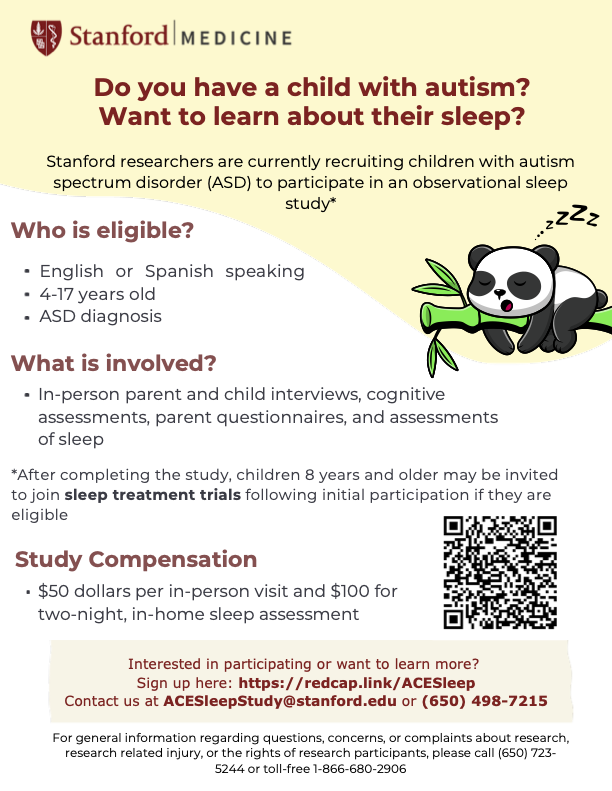
The Stanford Center for Sleep in Autism and NIH Autism Center of Excellence (ACE) Program invite you to participate in our research study aimed at understanding how sleep affects children with Autism Spectrum Disorder (ASD). Your participation will significantly contribute to advancing our knowledge of sleep physiology in children and teens with autism. Upon completion of this study, you can receive a research sleep study report and behavioral testing summary (upon request) and reimbursement up to $200. If your child has sleep difficulties and between the ages of 8 and 17 years old, they may also qualify for the sleep medication trials that we are also conducting as part of the Stanford Center for Sleep in Autism.
Who can participate?
You may be eligible if your child:
– Is between the ages of 4 and 17 years old
– Has a clinical ASD diagnosis
– Is English or Spanish speaking
– Is located in the Bay Area or is willing to travel to Stanford
What will participants be doing?
Our study involves in-person cognitive & behavioral assessments, an in-home two-night sleep monitoring session (polysomnography, actigraphy, and saliva collection), and a daytime EEG.
Each participant will actively participate in the study for approximately 1 month including the time for the systematic desensitization process. Participant will actively participate in the study for two nights for 8-10 hours in their homes, 1-2 hours of daytime EEG at Stanford University’s Department of Psychiatry and Behavioral Sciences, and neuropsychiatric and neurocognitive evaluation for 2-3 hours during a scheduled, daytime visit to Stanford University’s Department of Psychiatry and Behavioral Sciences.
Why is this important?
As many as 80% of children with Autism Spectrum Disorder (ASD) experience caregiver-reported sleep disruptions, including sleep fragmentation and delayed sleep onset. These sleep disruptions are one of the most burdensome symptoms reported by parents of children with ASD. Poor subjective sleep quality is associated with exacerbated severity of core ASD symptoms, including repetitive behaviors, social and communication difficulties.