
Predictors of Employment and Job Retention for Adults with ASD
What's the study about?
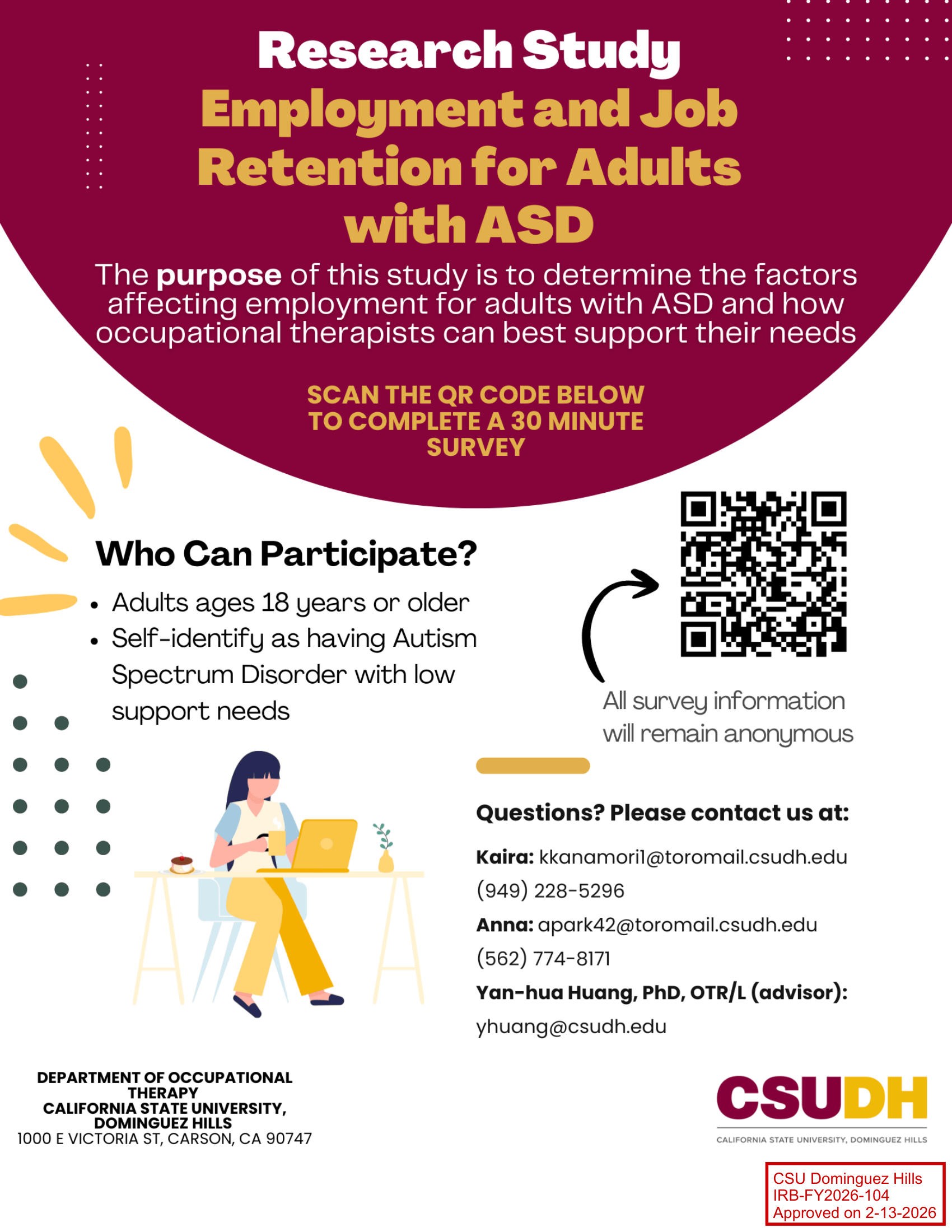
The purpose of this study is to determine the factors that contribute to employment and job retention for adults with low support needs ASD and how occupational therapists can best support their needs. The benefits associated with the study include those to society overall and contributions to the broader knowledge of ASD as a result of this study. There is no guarantee, however, that participants will receive any benefits from this study.
Who can participate?
Adults who self-identify as having Autism Spectrum Disorder with low support needs, ages 18 or older. Low support needs, or Level 1 Autism, is the mildest form of autism. They require support for communication and sensory environments, but not as substantially compared to Levels 2 or 3, which are more severe (Waizbard-Bartov et al., 2023). Study participants must be able to read and understand English.
Waizbard‐Bartov, E., Fein, D., Lord, C., & Amaral, D. G. (2023). Autism severity and its relationship to disability. Autism Research, 16(4), 685-696.
What will participants be doing?
Participants will complete an anonymous survey consisting of demographic and Likert scale questions. The survey will consist of questions asking about your financial well-being, social support, vocational training, and work experiences. The survey should take approximately 30 minutes in total to complete.
Why is this important?
This study is important because it helps identify the obstacles and assets that respectively hinder or support job procurement and the relationship between the employer and autistic employee.