
PROMISE: Predicting Outcomes from Movement in Infants using Sensors
What's the study about?
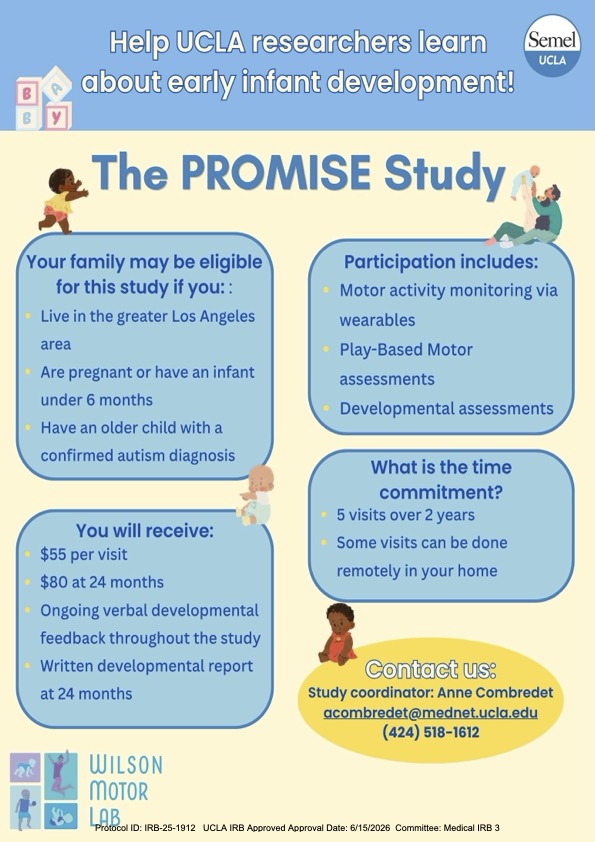
The PROMISE Study at UCLA is investigating whether early infant movement patterns can predict autism and other developmental differences in the first two years of life. We know that infants who have an older sibling with autism have a higher likelihood of developing autism and/or broader developmental differences. Using small wearable sensors placed on infants’ arms and legs alongside standardized developmental and behavioral assessments, we capture detailed data throughout the first two years of life to develop objective, reliable tools for earlier autism detection. Families are followed through 24 months, with visits conducted at home and at UCLA, and will receive developmental monitoring and feedback throughout the study.
Who can participate?
Families in the Greater Los Angeles area who are either currently pregnant or have an infant under 6 months of age, and who have at least one older child with a confirmed clinical diagnosis of autism. Monolingual Spanish-speaking families are welcome and encouraged to participate.
What will participants be doing?
Families will participate in 5 study visits over the first two years of their infant’s life. The first three visits (at 3, 6, and 9 months) can be conducted at home or at UCLA, while the final two visits (at 12 and 24 months) take place in-lab at UCLA. At each visit, infants will wear small sensors on their arms and legs to capture movement data over two days. Visits also include standardized developmental and motor assessments, parent questionnaires, and video recordings of free play, with more comprehensive behavioral and communication assessments added at 12 and 24 months. Parents will also complete brief online surveys before each visit. Each visit lasts approximately 1–3 hours. Families receive verbal developmental feedback throughout the study, a written developmental report at the 24-month visit, $55 per visit, and an additional $80 at the final visit.
Why is this important?
The average age of ASD diagnosis has remained at 4 years of age for decades, missing a critical window for early intervention when the brain is most responsive to support. This study aims to change that by identifying reliable movement-based markers of autism in the first year of life, well before behavioral signs emerge. Earlier detection means earlier access to intervention, which research shows leads to significantly better outcomes in language, social skills, and overall development. By developing objective, scalable tools for early autism detection, PROMISE has the potential to transform how autism is identified and to ensure that all families, including those who are under-resourced or Spanish-speaking, can access timely support for their children.