
What Is the Likelihood of Autism in the Children of Unaffected Siblings?
By Alison Singer
President, Autism Science Foundation
When an autistic person’s brother or sister is thinking about having a baby, it is natural for them to wonder whether their own child might be autistic. Fortunately, the science around recurrence risk is becoming clearer. Research shows that having an autistic aunt or uncle increases the risk of an autism diagnosis, but that likelihood appears to depend on which side of the family the autistic relative is on, whether that relative is a brother or sister, and the sex of the baby.
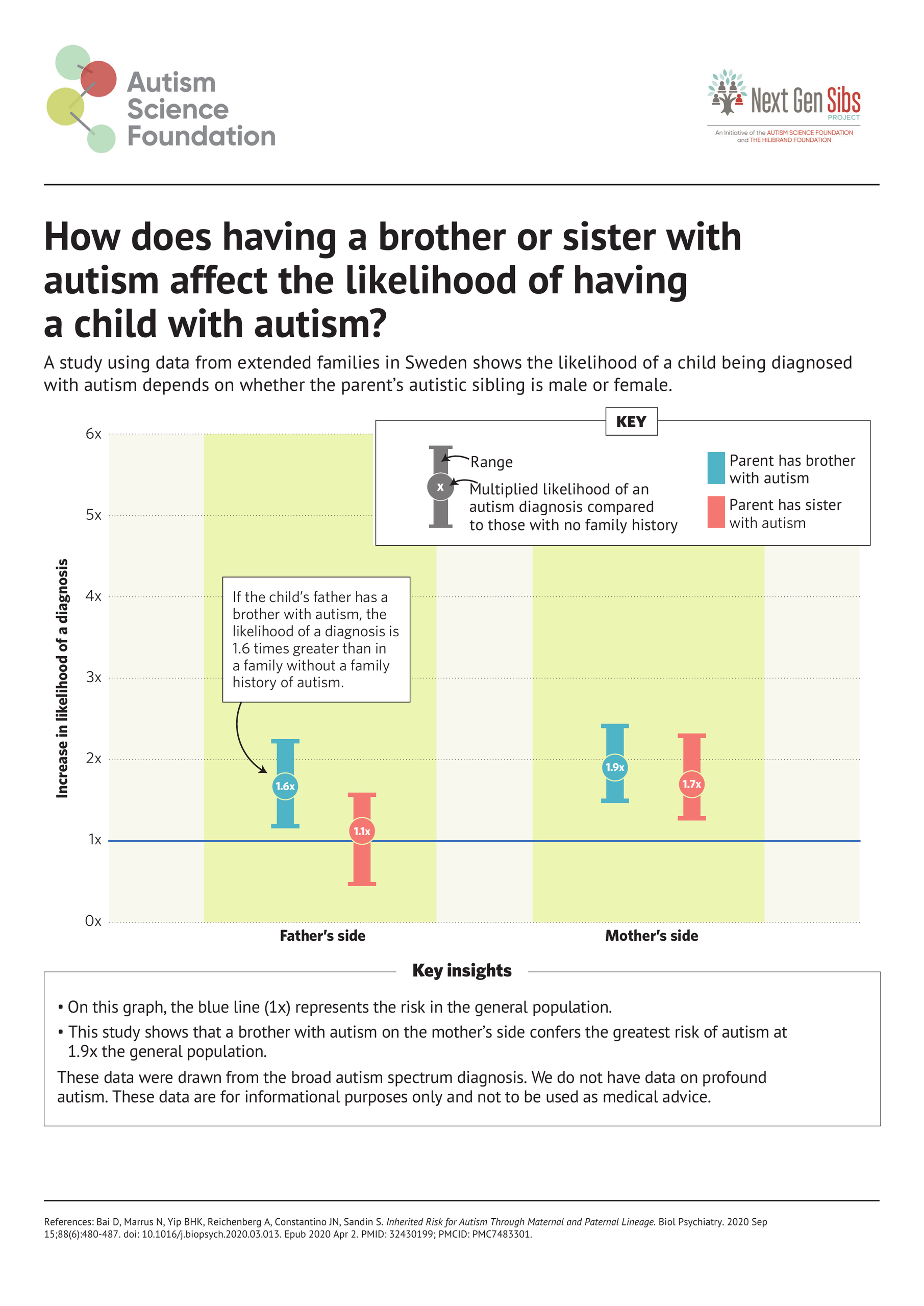
One of the largest studies to address this question analyzed over 840,000 children in Sweden and was published in 2020. Children whose mothers had a sibling with autism had a 3.05 times increased likelihood of an autism diagnosis than children without that family history. For children whose fathers had a sibling with autism, the likelihood was 2.08 times higher. (footnote 1). At the time, the prevalence of autism in the general population of Sweden was 1.5%. Risk increased to 3-5% when the child had an autistic aunt or uncle. (footnote 2)
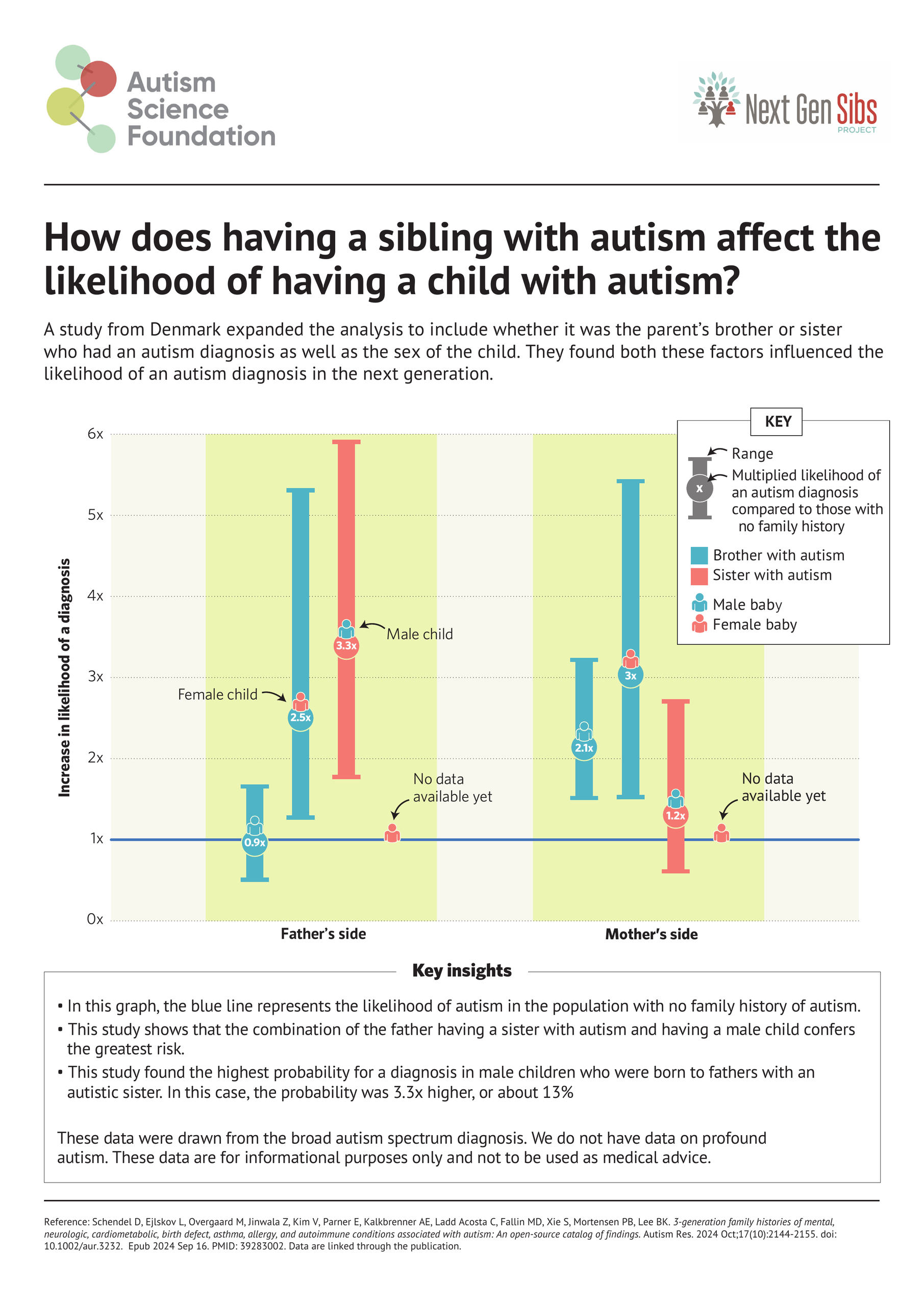
More recently, researchers in Denmark examined this question in considerably greater detail. The study included 1.7 million births and examined not only whether a parent had a sibling with autism, but also whether that autistic sibling was a brother or sister and whether the child was male or female. (footnote 3). As you would expect, the highest risk was in male children. It was 3.3x higher if the father had a sister with autism. Male children whose father had an autistic brother had an approximately 2.5 times higher likelihood of an autism diagnosis. On the mother’s side, male children whose mother had an autistic brother had an approximately 3 times higher likelihood, while female children in that group had an approximately 2.1 times higher likelihood. Some combinations did not have enough data to produce an estimate, particularly in girls who have a lower rate of diagnosis to begin with (footnote 3). These findings suggest that there is no single recurrence likelihood for nieces and nephews. The family tree matters, and the sex of the baby appears to matter as well.
This is consistent with research on younger siblings of autistic children. In the 2024 update from the Baby Siblings Research Consortium, 1,605 infants with an older autistic sibling were followed prospectively. Overall, 20.2% developed autism. Male infants had a 25.3% recurrence rate compared with 13.1% among female infants. The likelihood was also higher when the older autistic sibling was female: 34.7% versus 22.5% when the older sibling was male (footnote 4). These sibling data are important because they corroborate the idea that both the sex of the baby and the sex of the autistic relative can influence familial recurrence.
There is also a smaller study from Washington University in St. Louis that directly examined this next generation of offspring. Scientists followed 220 children born to 113 mothers who had an autistic sibling. 13.2% of those children had an autism diagnosis (19 of 111 boys and 10 of 109 girls) (footnote 5). While this finding is important because it directly addresses the population we are trying to understand, the sample was very small, and these results should therefore be considered preliminary rather than a definitive estimate.
What all of these studies suggest is that unaffected siblings may carry some of the familial, genetic liability for autism without meeting diagnostic criteria themselves, and that liability can be passed to their children. But we still have enormous gaps in our knowledge. We do not yet know the precise likelihood for every family situation; we cannot assume that findings from siblings of autistic children apply directly to nieces and nephews; and we don’t know how these patterns relate specifically to profound autism since the studies included people diagnosed with broader ASD, not just those with profound autism.
This is why the Autism Science Foundation’s Next Gen Sibs Project is so important. By prospectively following babies whose parent is an unaffected sibling of an autistic person, we can begin to answer questions that retrospective studies cannot. Does the baby’s sex alter risk? Does the sex of the autistic aunt or uncle matter? Does having more than one autistic relative change the picture, and if so, how? And with more research across different groups and with the help of genetic counselors, can this information eventually or ever be used to provide families with more accurate estimates based on the features in their family and extended family?
Families deserve answers that are neither falsely reassuring nor unnecessarily frightening. The science tells us that having an autistic aunt or uncle does increase the likelihood of autism, but certainly does not make an autism diagnosis inevitable. Our goal with Next Gen Sibs is to move from broad population estimates to precise, evidence-based information that families can use for family planning.
The family tree is telling us something important; our job is to follow the science carefully enough to understand what it is saying.
References
- Bai D, Yip BHK, Windham GC, et al. Inherited Risk for Autism Through Maternal and Paternal Lineage. Biological Psychiatry. 2020;88(5):438–445. doi:10.1016/j.biopsych.2020.03.006.
- https://www.nih.gov/news-events/news-releases/autism-risk-estimated-3-5-children-whose-parents-have-sibling-autism
- Schendel D, Ejlskov L, Overgaard M, et al. 3-generation family histories of mental, neurologic, cardiometabolic, birth defect, asthma, allergy, and autoimmune conditions associated with autism: An open-source catalog of findings. Autism Research. 2024;17(10):2144–2155. doi:10.1002/aur.3232.
- Ozonoff S, Young GS, Bradshaw J, et al. Familial Recurrence of Autism: Updates From the Baby Siblings Research Consortium. Pediatrics. 2024;154(2):e2023065297. doi:10.1542/peds.2023-065297.
- Ozonoff S, Young GS, Bradshaw J, et al. Familial Recurrence of Autism: Updates From the Baby Siblings Research Consortium. Pediatrics. 2024;154(2):e2023065297. doi:10.1542/peds.2023-065297.
- Marrus N, Turner TN, Forsen E, et al. “Genetic counseling as preventive intervention: toward individual specification of transgenerational autism risk.” Journal of Neurodevelopmental Disorders. 2021;13:39. doi:10.1186/s11689-021-09389-8