
Acquisition and generalization of pivotal language skills using SentenceWeaver: A preliminary investigation
What's the study about?
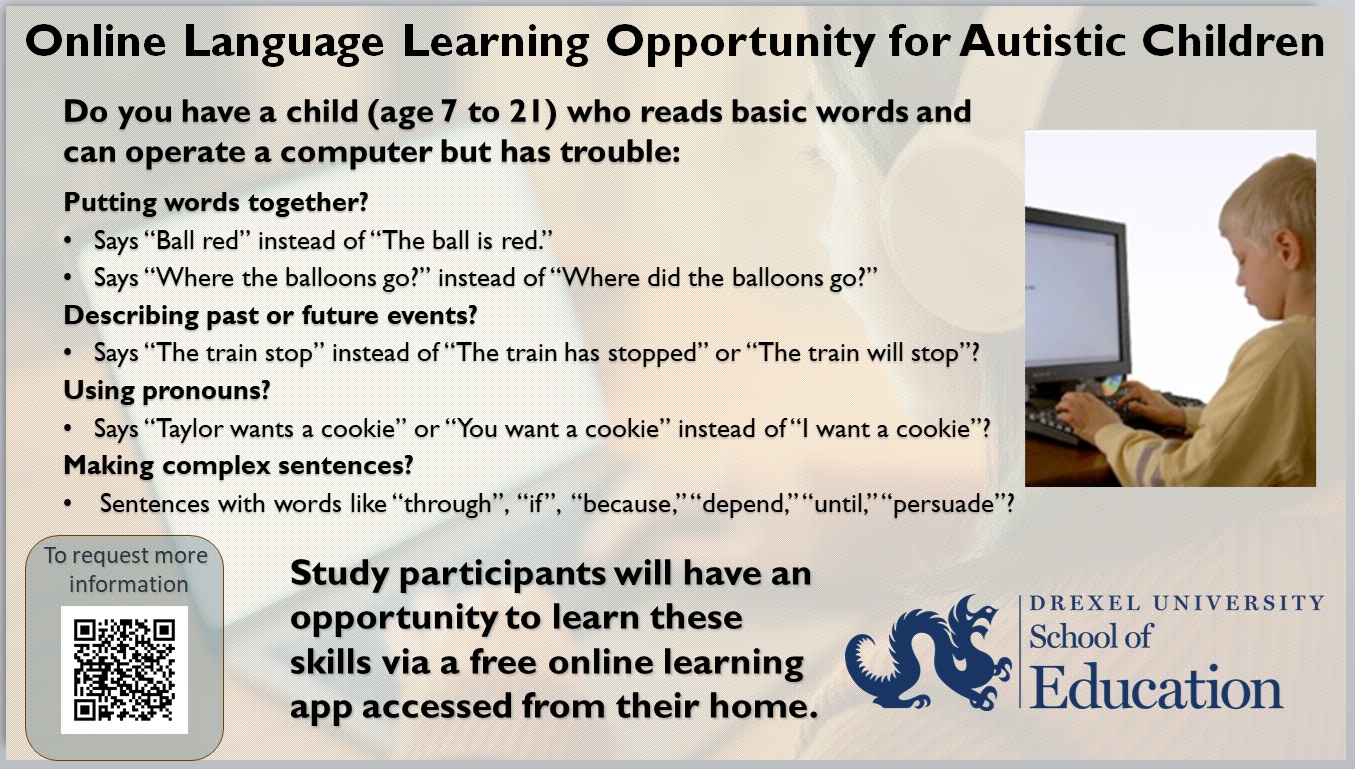
This study examines the acquisition and generalization of pivotal language skills using the SentenceWeaver, a computerized language training curriculum that instructs all the basic morpho-syntactic structures of English, as well as such pragmatics skills as contextually appropriate question-asking, verb-tense selection, and pronoun selection: core language challenges that often co-occur with autism and other related language disorders. The study will measure the extent to which individuals with autism and other related language disorders can acquire and generalize pivotal language skills through an interactive computerized language program (SentenceWeaver).
Who can participate?
We will recruit up to 50 children (age < 18) with an autism and/or a related language disorder diagnosis whose parents describe them as having difficulty with formulating questions, difficulty with verb tenses, or difficulty with pronouns.
What will participants be doing?
Participants will spend 20-30 minutes per day, 3-4 days per week accessing the software over the internet. The program’s exercises require the participants to construct (via typing or clicking word buttons from a menu) sentences using nouns/pronouns and verbs/negated verbs in different tenses in response to verbal and picture prompts. The software program gives color-coded, linguistically-informed corrective feedback and requires the participant to fix and resubmit their response until it is error-free before they can move on to the next trial.
Why is this important?
An estimated one third of the ASD population can put words together but struggle with expressive language, in particular, with question-asking, verb tenses, and pronouns [1]. These challenges can limit communication to simple, here-and-now statements and, in the case of pronouns, communication failure. Multiple studies have found that students with ASD prefer remote, computerized language training to in-person instruction and have been able to demonstrate improvement in language skills with such programs [2, 3]. However, no such computerized programs have systematically targeted and explicitly required expressive production of language. The SentenceWeaver’s (SW) teaching methodology is innovative in three respects. First, it provides open-ended, interactive training in sentence construction. Second, it requires users to construct sentences from scratch rather than by filling in blanks or ordering small groups of pre-selected phrases. Third, it provides users with detailed feedback – including incorrect word choices, word endings and word order – and opportunities for error correction rather than simply marking an answer as incorrect. In these respects, SW provides repeated practice with the real-world demands of sentence formulation and gives users an active role in making sense of and fixing their errors.
A pilot study on a SW verb tense module showed significant gains from the pre-test to post-test measures for one participant.
References:
[1] Kim, S. H., Paul, R., Tager-Flusberg, H., & Lord, C. (2014). Language and communication in autism. In F. R. Volkmar, S. J. Rogers, R. Paul, & K. A. Pelphrey (Eds.), Handbook of autism and pervasive developmental disorders: Diagnosis, development, and brain mechanisms (4th ed., pp. 230–262). John Wiley & Sons, Inc.
[2] Bosseler, A., & Massaro, D. W. (2003). Development and evaluation of a computer animated tutor for vocabulary and language learning in children with autism. Journal of Autism and Developmental Disorders, 33(6), 653–672.
https://doi:10.1023/B:JADD.0000006002.82367.4f
[3] Chen, S. H. A., & Bernard-Opitz, V. (1993). Comparison of personal and computerized instruction for children with autism. Mental Retardation, 31, 368–376. PMID:8152382