
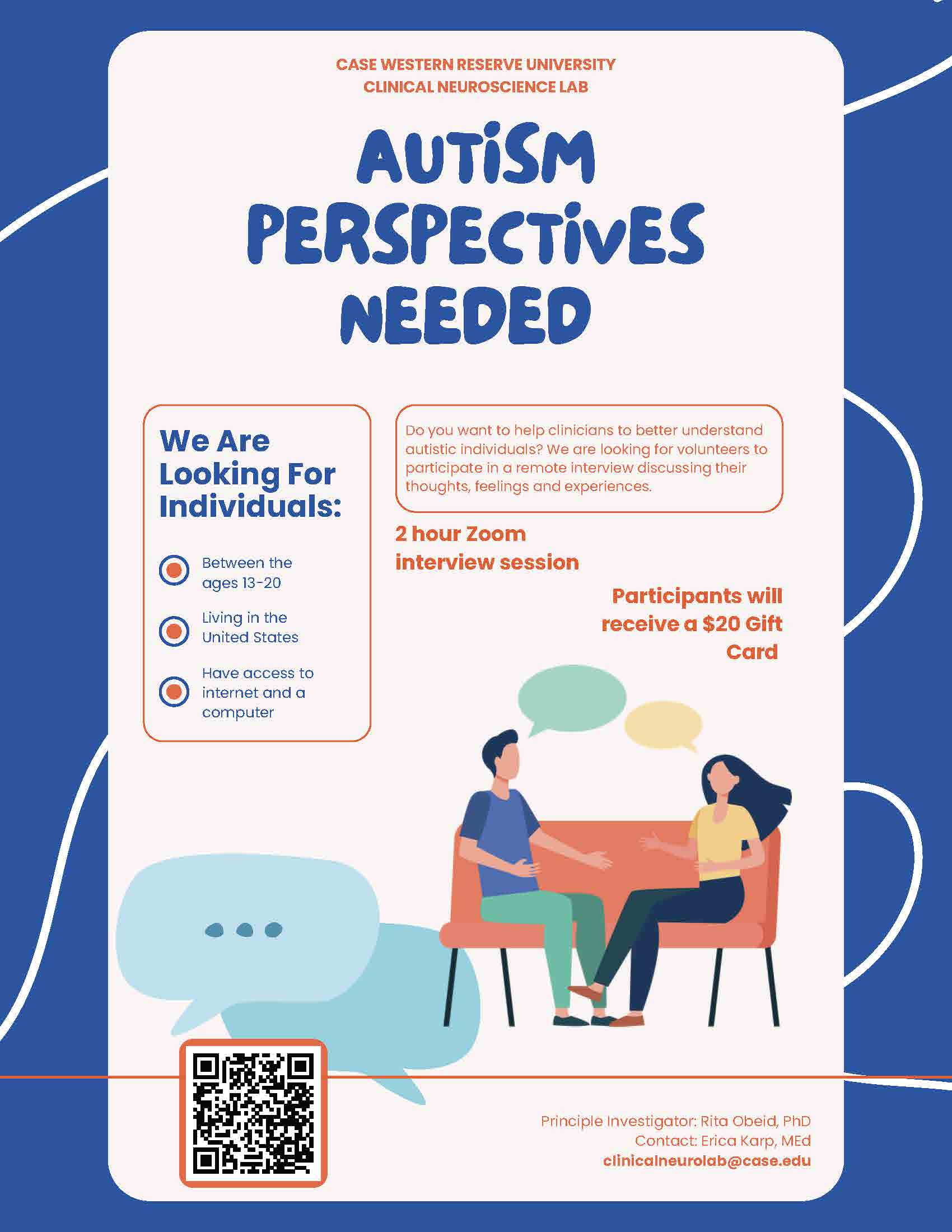
Autism Perspectives: Do you want to help clinicians to better understand autistic individuals?
What's the study about?
Prevalence rates of cooccurring autism (ASD) and psychosis vary widely, ranging from <1%-76%, and are impacted by a multitude of factors. One factor includes a lack of comfortability with assessing psychotic symptoms in autistic individuals as well as individual-level factors impacting self-insight such as cognitive abilities. The present study aims to examine the feasibility of using a clinical interview for psychotic symptoms with autistic individuals and test whether an individual-level factor (i.e., ASD severity, social cognition) impacts autistic individuals’ responses to questions regarding psychotic symptoms. Determining if autistic individuals can self-report on their psychotic like experiences will help increase the utilization of existing psychological tests for psychotic symptoms with this population which in turn will lead to a more accurate prevalence rate of cooccurring ASD and psychosis. Additionally, identifying aspects of autism that may be increasing clinician’s difficulty to identity psychotic symptoms will help inform adaptations or modifications to psychological tests that can be standardized and systematically implemented.
The goals of this project are to determine if a semi-structured interview can be appropriately utilized to assess psychotic symptoms in autistic individuals. Currently there are concerns about autistic individuals having a level of insight sufficient to report on internal experiences, such as hallucinations and delusions, yet we know that rates of psychosis in autistic individuals are higher than the general population making this a critical area to investigate. This project seeks to clarify the validity of this concern around testing. An additional goal is to do determine if there are aspects of autism that may make administering the psychological test more difficult for psychologists without autism experience.
Who can participate?
Autistic young adults between the ages of 13-20 residing in the US and English as their primary language.
What will participants be doing?
Participants will complete an interview and questionnaires over Zoom.
Why is this important?
This study will help inform how we conduct clinical interviews with autistic individuals and identify areas in which clinicians may need to adapt a more neurodiverse approach.