
Autism Research in Kids (ARK)
What's the study about?
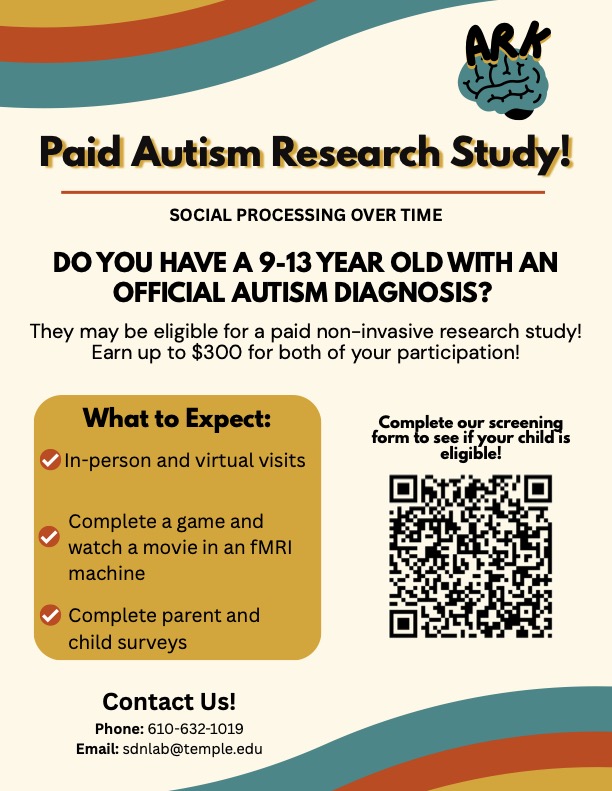
We are conducting a research study to better understand how the brain responds to rewards — like social praise or money — in children and adolescents with autism, ages 10-15. This study uses a new, non-invasive type of MRI scan to look at brain chemistry (specifically, a system involved in motivation and reward) and how it relates to autism symptoms. Participation involves one remote (Zoom) session and two in-person visits at Temple University, which include an MRI scan, some questionnaires, and computer-based tasks. This study is conducted in collaboration with the Center for Autism Research at Children’s Hospital of Philadelphia (CHOP) and is approved by our university’s IRB.
Who can participate?
Children/adolescents aged 9-15
What will participants be doing?
Participants will complete three sessions totaling approximately 5 hours. During the first session (2 hours, conducted remotely over Zoom), the study team will review consent with the parent and assent with the child, followed by the Kaufman Brief Intelligence Test (a brief cognitive assessment) and some questionnaires. The second session (1 hour, in person at Temple University) involves a practice MRI scan to help the child get comfortable with the scanner, along with additional questionnaires. The third session (2 hours, in person at Temple University) includes the Rey Auditory Verbal Learning Test and a Flanker task (computer-based cognitive tasks), followed by the actual MRI scan, during which participants will complete a reward-based task and watch a movie. No blood draws or other specimen collection are involved.
Why is this important?
This study is important because it could help us better understand the brain differences that contribute to social challenges in autism — and, in the long run, lead to more effective, individualized treatments. Many current interventions for autism rely on rewarding desired behaviors to encourage learning and social engagement, but we don’t yet know whether some autistic individuals may benefit less from these approaches due to differences in how their brains process reward. This study uses a novel, non-invasive brain imaging technique to measure dopamine system function (a brain chemical involved in motivation and reward) for the first time in autistic adolescents. By identifying whether and how reward processing differs in autism, this research could eventually help clinicians match individuals to the interventions most likely to work for them, and could open the door to new medication-based treatments — something that does not currently exist for the core social symptoms of autism.