
Bilingualism in Autism Spectrum disorders: effects on cognition and language
What's the study about?
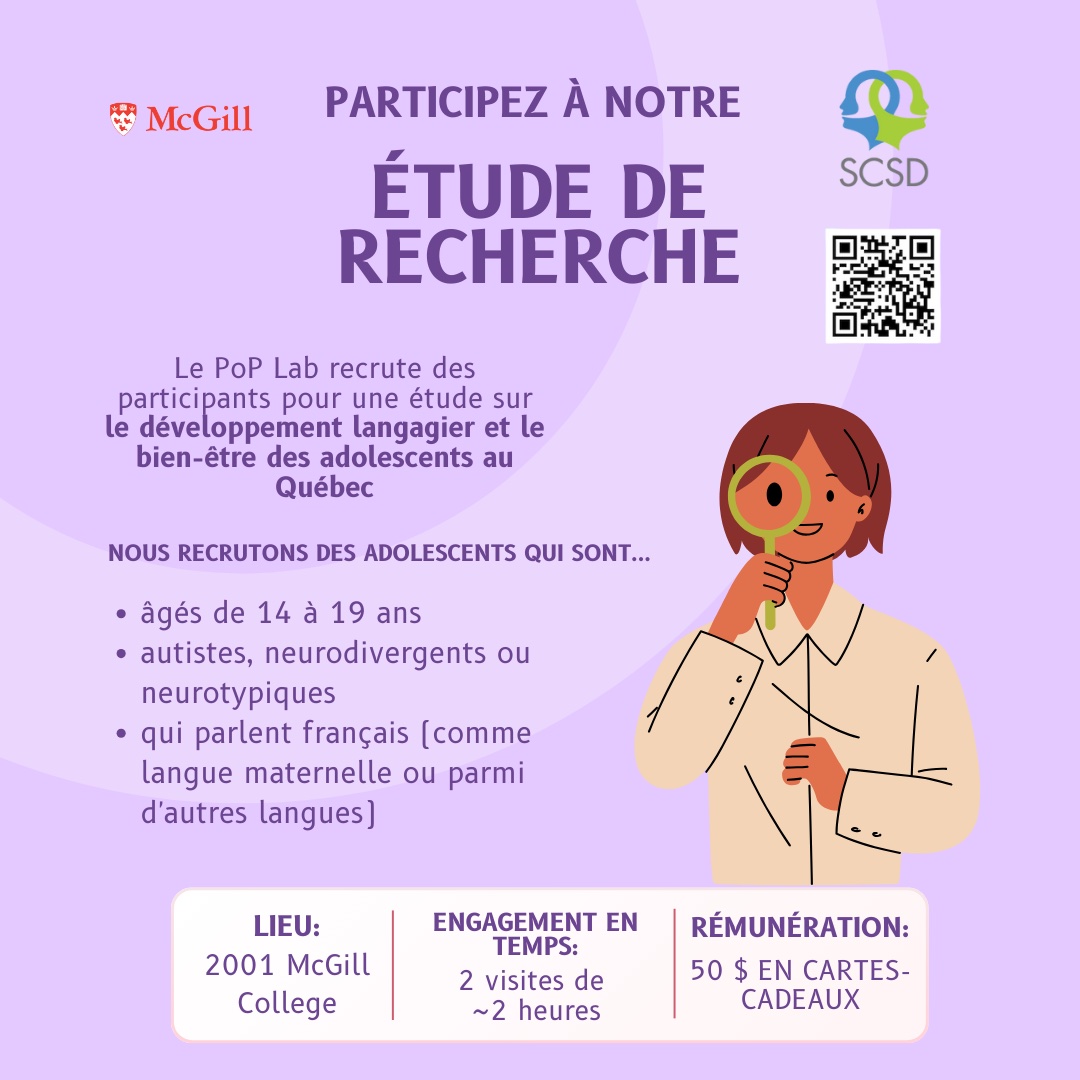
This study investigates language development, cognition, and well-being among multilingual adolescents in Quebec, including minority language speakers. We take an intersectional approach by examining both typically developing and neurodivergent youth.
Who can participate?
We are recruiting 14- to 19-year-olds for our study which examines the development of adolescents in Quebec who are autistic, neurodivergent or neurotypical. We are focusing on adolescents who speak French, or French in addition to other languages.
What will participants be doing?
The study is conducted entirely in French and involves two visits, lasting two hours each, in our lab in downtown Montreal (by metro McGill). Participants will receive $ 50 in gift cards over the two visits. Their caregiver will also be invited to fill out questionnaires (in English or French) and will receive a $ 15 gift card.
Tasks include questionnaires on their background, well-being and language use. Participants will also complete language-based tasks on grammar, storytelling and persuasion, as well as executive function tasks.
Why is this important?
The majority of autism research has been conducted with monolingual and English-speaking populations, limiting our understanding of development in bi- and multilinguals who make up and increasingly large part of the population around the world. This study also focuses on and understudied developmental period in autism research: adolescence. The insights we gain about language, cognition and well-being will contribute to a more inclusive understanding of autistic youth. Our findings will have practical implications for those directly involved in supporting youth, including families and practitioners such as social workers, psychologists, educators, and speech-language pathologists.