
Early Literacy Skills in Autistic and Non-autistic Children
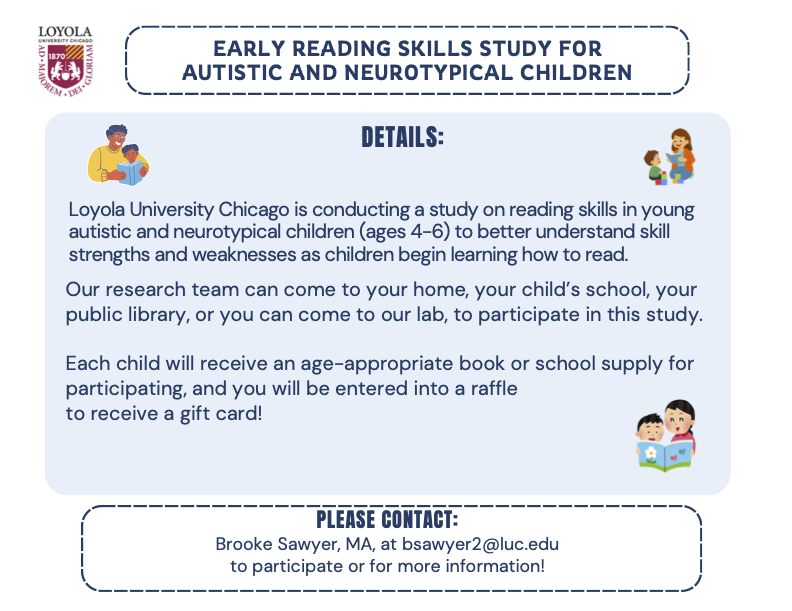
What's the study about?
This study looks at the similarities and differences in early reading skills in autistic and non-autistic children, as well as what factors may contribute to stronger reading skills in young autistic children. In addition, this study explores whether parent-child joint attention behaviors may inform reading skill outcomes. This study also includes an opportunity to participate in a pilot multimodal educational reading skills intervention program after the initial visits have been completed.
Who can participate?
Verbal autistic children, ages 4-6, with a parent or caregiver.
What will participants be doing?
An autistic child and their parent will complete a 10-minute play observation that is either video-recorded or observed by a research team member.
Then, autistic children will complete an abbreviated IQ assessment, a receptive vocabulary measure, an expressive vocabulary measure, a code-related emergent literacy skills measure, and a processing time measure.
Parents will complete an informational questionnaire, an autism symptomatology measure, an executive functioning measure, and a home literacy questionnaire.
All child measures are expected to take 60 minutes and can be split across two sessions. Parent measures are expected to take 20 minutes in total to complete.
Why is this important?
The purpose of this study is to understand the similarities and differences in young autistic and non-autistic children’s early reading abilities before they enter elementary school. Learning to read is not only important for academic success, but also for quality of life. Previous studies have shown that reading skills may be challenging for autistic children, yet few assess the specifics of these impairments. Thus, the primary goals of this study are to 1. examine the emergent literacy skills of autistic children in comparison to their typical peers, 2. understand how vocabulary, attention, and processing time may relate to reading abilities, and 3. use this greater understanding to inform an educational program to allow parents to teach reading skills to autistic and neurotypical children. The educational program that this study will inform may allow for earlier acquisition of reading skills and comprehension that will help autistic children both succeed in school and have a higher overall quality of life.