
EEG investigation of emotion regulation and memory
What's the study about?
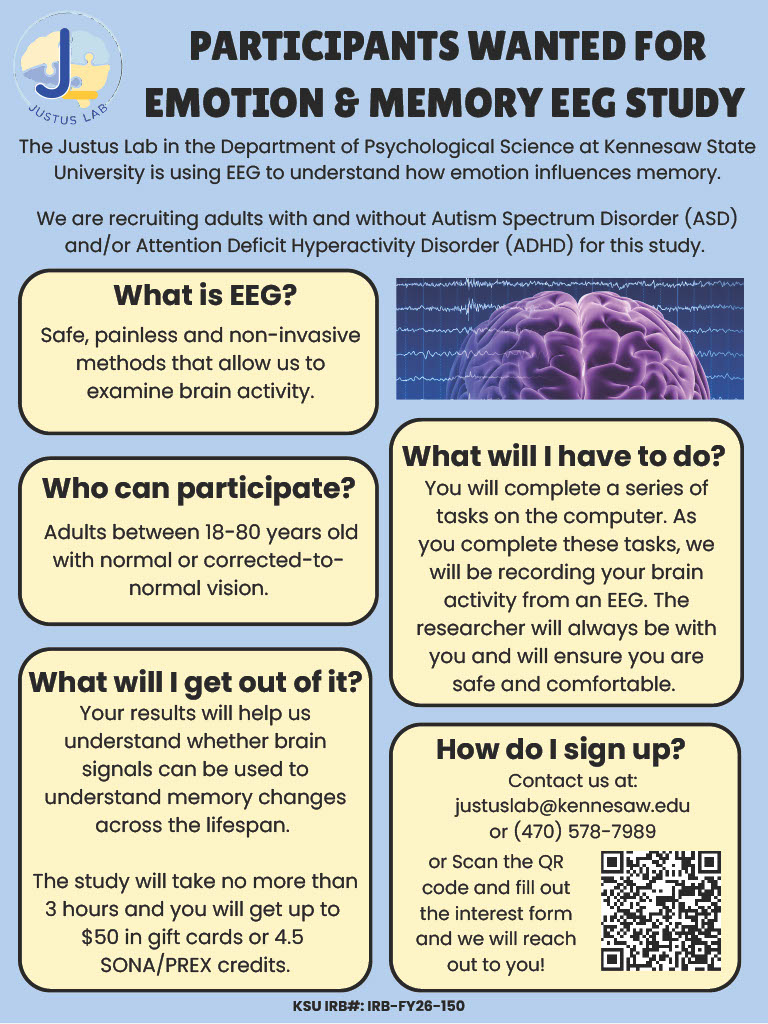
The purpose of this study is to understand how individual differences in emotion regulation contribute to differences in memory across the adult lifespan. Specifically, we want to understand how emotion regulation can affect our memory ability and the underlying neural signals that support this process.
Who can participate?
You must be between the ages of 18-80 and have normal or corrected-to-normal vision to participate.
If you have any of the following, you will be excluded from this study for your own safety: epilepsy, a history of stroke or seizure, brain damage, loss of consciousness, multiple sclerosis, untreated cataracts, untreated glaucoma, macular degeneration, or regular illegal drug use.
What will participants be doing?
If you decide to be in this study, you will first complete some questionnaires about your demographics, health, mood, symptoms of various clinical disorders, and a brief cognitive assessment. Then, you will be fitted with an EEG electrode cap. To get good contact between the electrode sensors and your scalp, we may use an alcohol pad or exfoliating paste to remove surface oils and dirt. A small amount of conductive gel will then be applied to the spaces in the cap to connect the electrodes. This conductive gel will get in your hair, but it can be washed out once you leave the lab. A sensor will also be placed underneath your eye using a removable patch. The EEG measures electrical activity produced by your brain. Because movements may disturb the EEG, you will be asked to remain as still as possible and avoid unnecessary movements (e.g., jaw clenching, chewing, excessive eye blinks) while we record your EEG. We will provide you with breaks during the task to give opportunities for movement. Please ask the researcher any questions that you have while you are doing the tasks.
Once capped for the EEG, you will be shown pictures and/or letters on a computer screen and asked how well you remember these stimuli. Some of the pictures you see display filth, gore, and nudity. These pictures have been used in numerous prior research studies. You are asked to make responses using the computer mouse and keyboard during this task.
After the computer/EEG task, you will complete a debriefing form, and the EEG cap will be removed. The conductive gel will be left in your hair after you leave the lab. You will be offered a new comb (which you can keep) and directed to the bathrooms in the facility if you would like to comb or wipe the gel through your hair. You may wish to bring a hat, hair covering, or hair tie to help conceal the gel when you leave our lab. The total time in the lab for this study will not exceed three hours.
Why is this important?
The broader community may benefit by learning more about how the brain reacts to emotional stimuli during memory tasks.