
Exploring Character Strengths and Well-Being Among Autistic College Students
What's the study about?
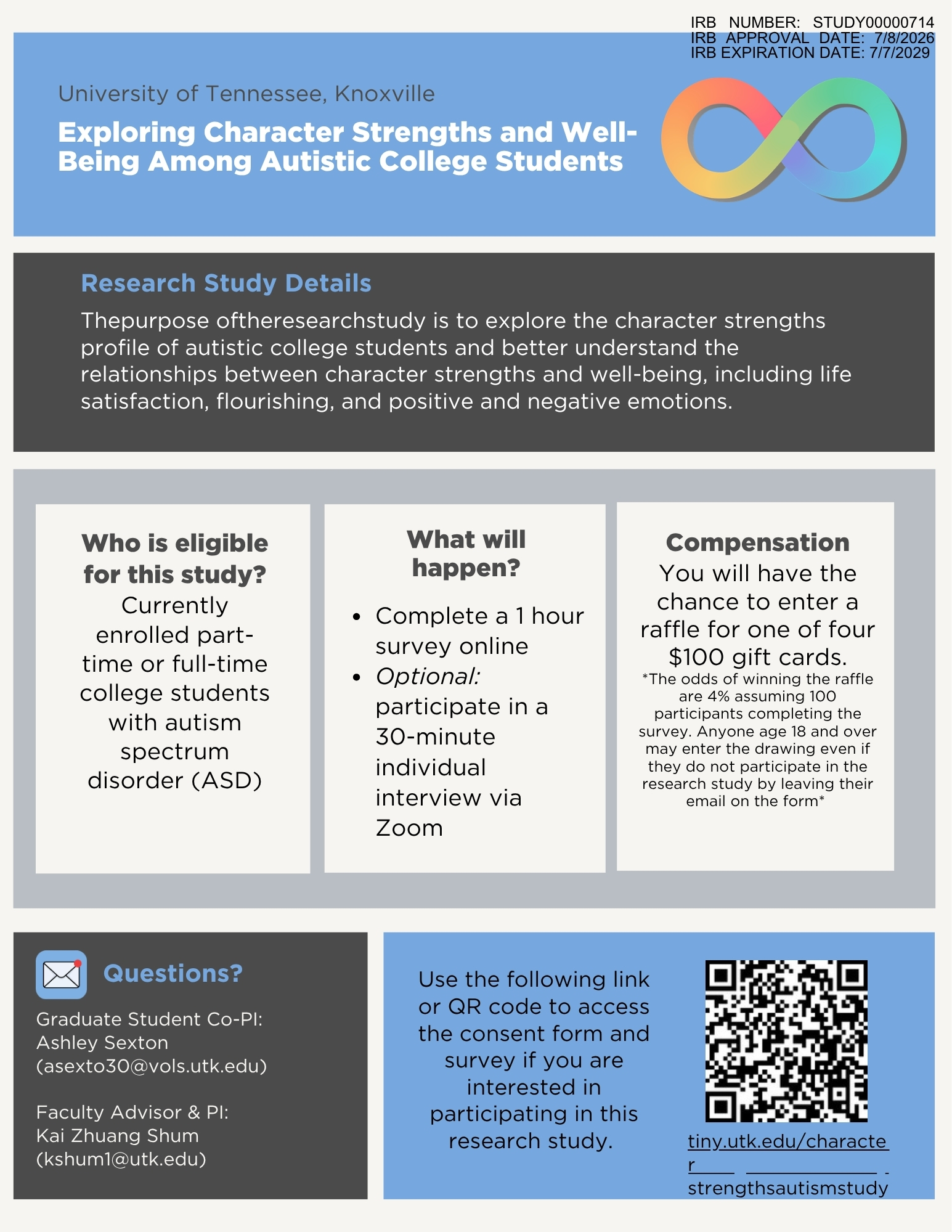
The purpose of this study is to explore the character strengths profile and usage of character strengths in autistic college students. This study also seeks to examine the relationships between character strengths, life satisfaction, flourishing, and positive and negative emotions within this group. A convergent mixed-methods design will be used. In this study, survey data will be used to describe the character strengths profile of autistic college students and examine the relationships between the use of character strengths and measures of well-being. Qualitative data collected via virtual individual interviews will explore how autistic college students use their character strengths, as well as their perceptions of how the use of their character strengths impacts their emotions, engagement, relationships, meaning, and accomplishments in life.
Who can participate?
The inclusion criteria for participants include: 18 years of age or older, enrolled as a part-time or full-time student at one public or private university, and is diagnosed with autism spectrum disorder (ASD) by a medical provider or self-identified as having autism.
What will participants be doing?
Participants will complete a 1-hour online survey and have the option to participate in a 30-minute virtual interview.
Why is this important?
Autistic individuals often experience poorer well-being than non-autistic individuals due to an increased likelihood of anxiety and depression (American Psychiatric Association, 2022; Hollocks et al., 2019). Positive psychology interventions (PPIs), such as identifying and utilizing one’s character strengths (Seligman et al., 2005), have been shown to increase positive affect and life satisfaction, as well as reduce anxiety and depression (Carr et al., 2021; Schutte & Malouff, 2019). Although there is a need for mental health support in the autism population, and PPIs have been shown to improve well-being, research on PPIs in this population is limited. Data gathered from this study may inform future development of character strengths interventions for individuals with autism.