
Family-Based Mobile Health Intervention to Enhance Physical Activity and Social Connectedness in Autistic Transition-Age Youth
What's the study about?
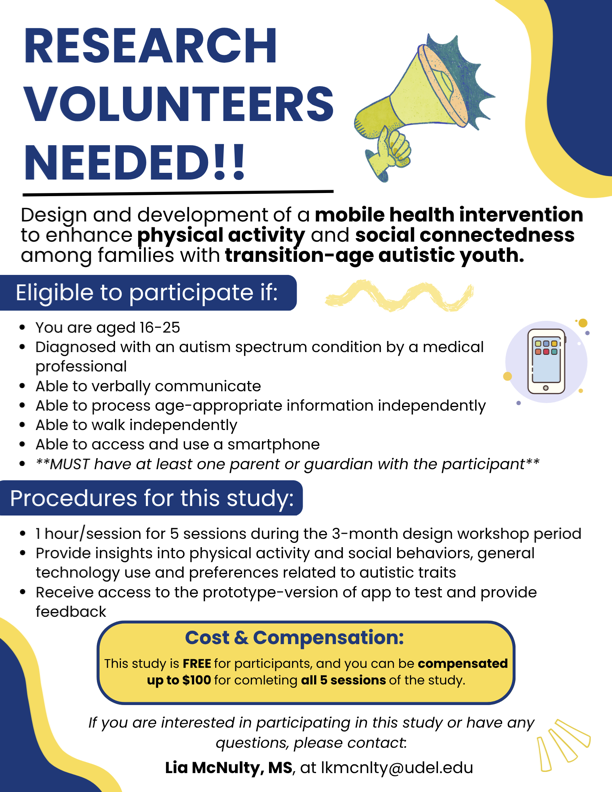
Autistic youth transitioning to adulthood (ages 16–25) may face challenges with being physically active and maintaining social connections. These challenges can affect overall health and well-being. Parents and caregivers can play an important role in supporting healthy behaviors during this transition. However, many health programs are designed for the general population and may not reflect the needs, preferences, and experiences of autistic individuals. Technology-based programs, including mobile apps and gamification (such as points, rewards, and challenges), may provide new ways to support physical activity and social connectedness. This study aims to co-design a gamified mobile app to support physical activity and social connectedness among autistic youth transitioning to adulthood.
Who can participate?
The study will involve autistic individuals aged 16–25 and their parent/guardian working together as family dyads.
Autistic transition-to-adulthood aged individuals are eligible for this study if they are:
1) aged 16-25,
2) diagnosed with an autism spectrum condition by a medical professional,
3) able to verbally communicate,
4) able to process age-appropriate information independently,
5) able to walk independently (without the assistance of a mobility device/another person),
6) able to engage in physical activity without medical supervision as determined by the Physical Activity Readiness Questionnaire (PAR-Q),
7) able to access and use a smartphone, and
8) living within the household of the participating parent/guardian.
Parents/guardians are eligible for this study if they are:
1) 18 years or older,
2) an immediate caregiver within the family of an autistic individual also participating in the study,
3) able to verbally communicate,
4) able to process age-appropriate information independently,
5) able to walk independently (without the assistance of a mobility device/another person),
6) able to engage in PA without medical supervision as determined by the PAR-Q, and
7) able to access and use a smartphone.
What will participants be doing?
Participants will take part in five virtual group-based workshops (60-90 minutes each) to share their experiences, needs, and preferences related to physical activity, social connectedness, and mobile technology. Participants will also provide feedback on a mobile app prototype during the workshops. Some brief online surveys will be used as well.
Why is this important?
This study is important because many health programs and technologies are not designed with the unique needs, preferences, and experiences of autistic individuals in mind. By involving autistic youth and their family members in the design process, this study aims to develop a mobile app that better supports physical activity and social connectedness during the transition to adulthood.