
Harnessing the Power of the C-K Visuomotor Training for Functional Improvement and Adaptive Brain Reorganization in Autism Spectrum Disorder
What's the study about?
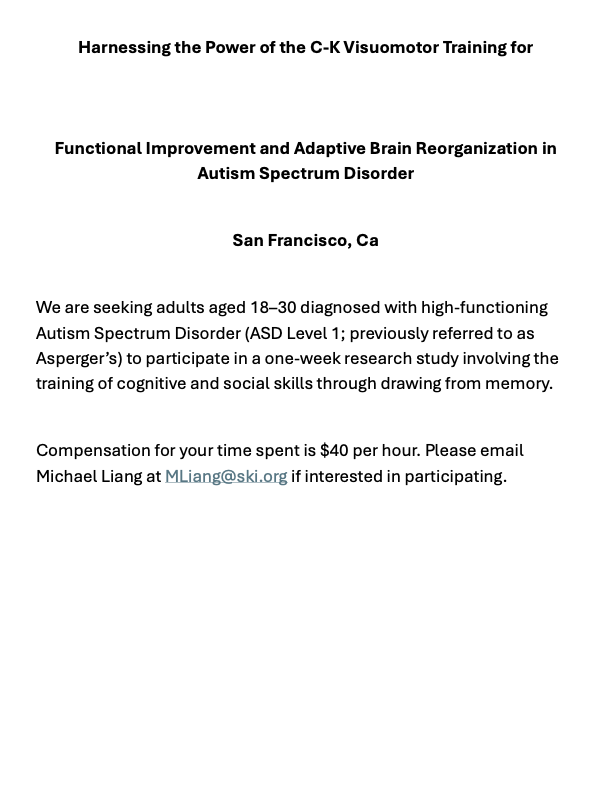
This is a funded preliminary study for a larger program that aims to harness the power of the PI’s successful and efficient Cognitive-Kinesthetic (C-K) Training for individuals with high-functioning ASD, employing visual and tactile-memory drawing for improved cognitive/behavioral abilities, social communication, functional independence and quality of life, and to understand the underlying neural mechanisms of their training-driven brain reorganization. The training takes one week, for 2 hours/day, so is much shorter than typical ASD rehabilitation methods, but has been shown to be of substantial benefit in the other communities.
Who can participate?
Adults 18-30 with high-functioning ASD willing to participate in the procedures.
What will participants be doing?
Training. Participants will be trained to draw from memory (a week of two hours per day) through the Cognitive- Kinesthetic rehabilitation method, images designed to enhance awareness and functionality in their diagnostic areas of weakness associated with their ASD status.
Behavioral Tests: Behavioral tests will be administered before and after the training to assess their ASD status, spatio-cognitive status and other measures such as sensory discrimination, spatial analysis and face recognition at intervals during the study.
Functional MRI exam. Before and after the training, participants will also be asked to perform a series of cognitive tasks while in the MRI scanner to measure brain function. The procedure is that they will be provided with an fMRI-compatible drawing lectern that allows the real –time capture of the drawing trajectories that will be used for providing error feedback.
Why is this important?
This is a funded pilot study to collect preliminary data for a full-scale study of the effectiveness of the Cognitive-Kinesthetic training approach in the ASD population. These data are required to justify funding for the full-scale project. If successful, it will provide a new conceptual approach to the amelioration of the ASD condition, enhancing quality of life for the expenditure of only a one-week training commitment.