
Language and the Brain in Autism
What's the study about?
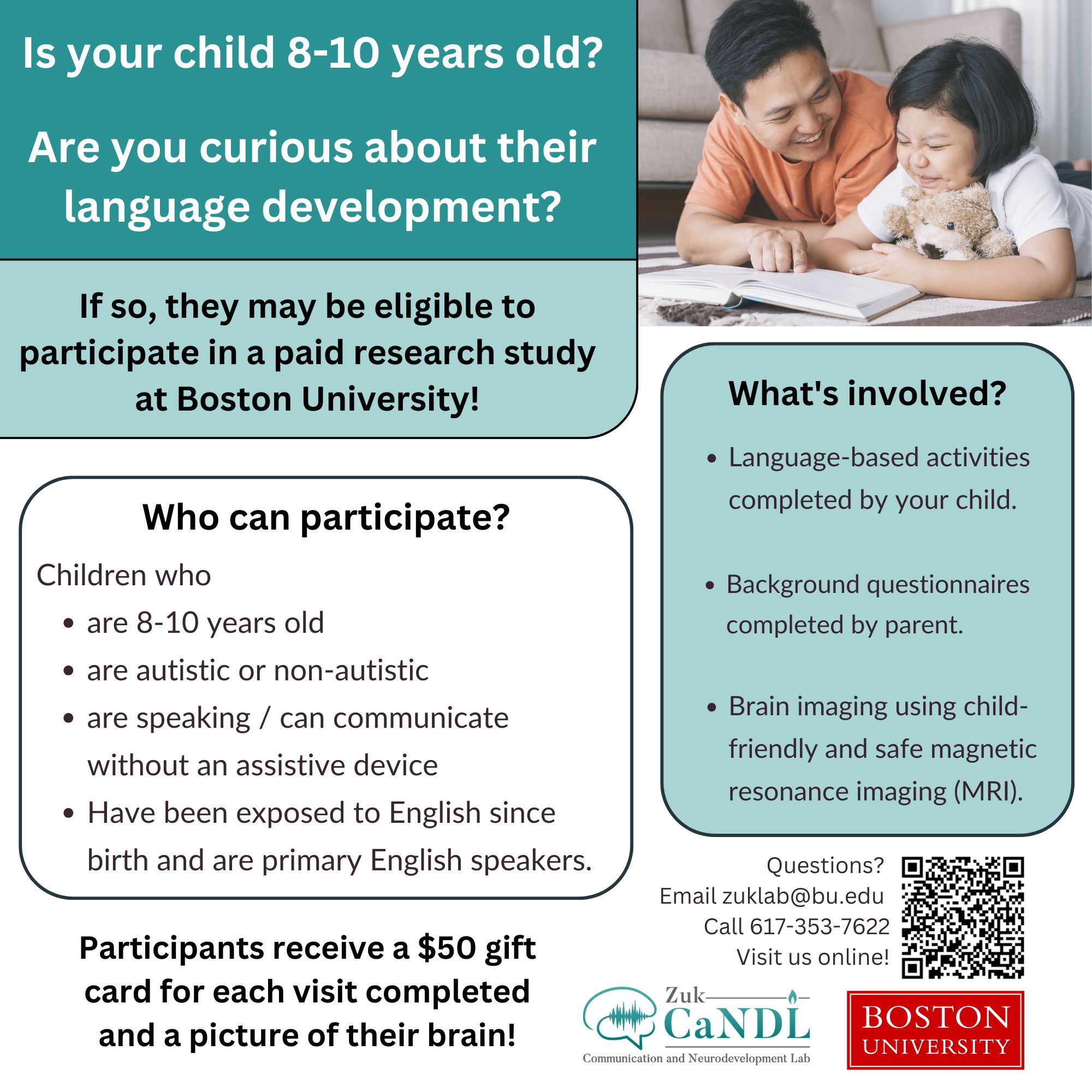
The purpose of this research study is to better understand speech, language, and listening skills in children with and without autism, also referred to as autism spectrum disorder (ASD). Communication abilities heavily rely on one’s ability to leverage and understand speech prosody (includes features such as pitch, timing, and rhythm). The goal of this study to identify key differences in speech and language perception and production in children with autism. To reach this goal, we will use behavioral and imaging assessments to measure speech and language in children with and without autism.
Who can participate?
Children ages 8-10 with or without an autism spectrum disorder diagnosis who have been exposed to English from birth.
What will participants be doing?
This study involves a total of 3 sessions. The sessions will take place at the
Communication and Neurodevelopment Lab (CaNDL) at Boston University. Each session will take approximately 2-2.5 hours with a total of 6-7.5 hours for participation.
All participants taking part in this study will complete two behavioral testing sessions Your child will complete paper-and-pencil and computer-based activities that involve seeing, listening, and responding to sounds, words, sentences. Parents will be asked to complete background questionnaires.
Participants will also complete a neuroimaging session. Your child will complete a magnetic resonance imaging (MRI) session to measure your child’s brain structure and function. Before completing the MRI, your child will complete a child-friendly training session to learn about MRI and to practice laying still to complete activities.
Why is this important?
The purpose of this study is to better understand speech, language, and listening skills in children with and without autism. The purpose of the MRI session is to help us learn about brain structure and function relates to speech, language, and listening skills in children with and without autism. The goal of this study to identify key differences in speech and language perception and production in children with autism.