
Medication Research on Inflexible and Repetitive Behaviors
What's the study about?
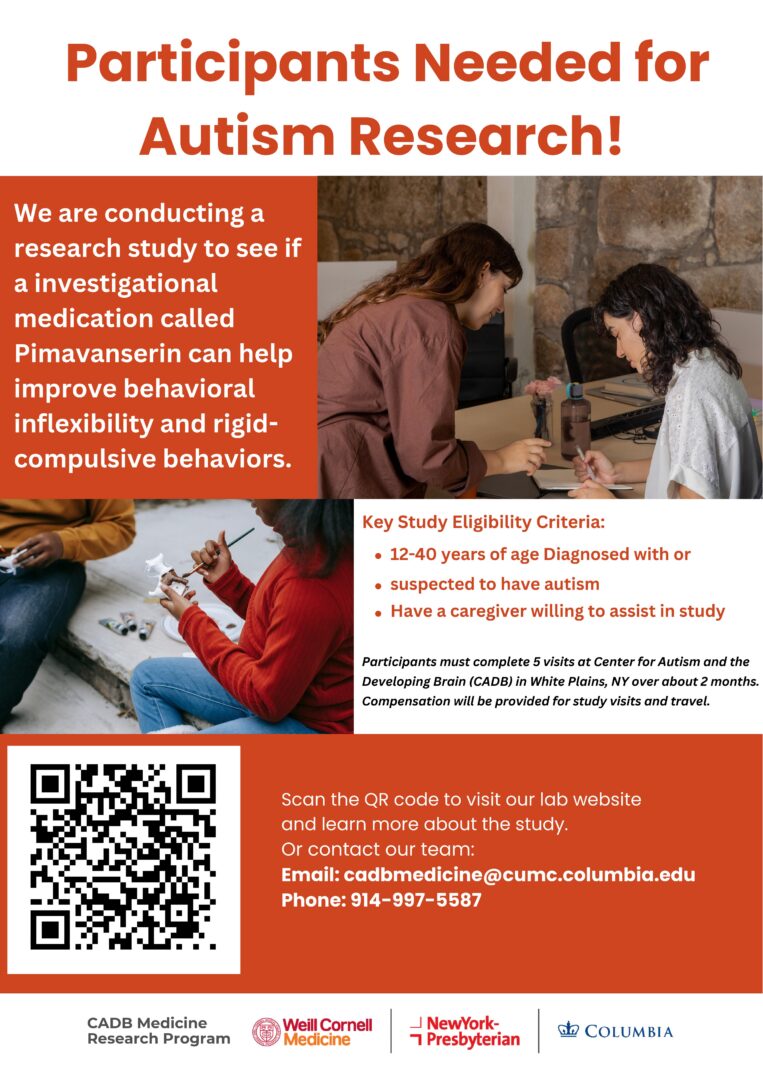
The purpose of this study is to see if an investigational medication called pimavanserin may improve behavioral inflexibility and repetitive behaviors in adolescents and adults with autism spectrum disorder (ASD).
Currently, pimavanserin is used for treatment of hallucinations and delusions in Parkinson’s disease. This medication is now being studied to see if it might help autistic individuals with inflexibility and repetitive behaviors.
The use of pimavanserin in this study is considered investigational.
Who can participate?
Participant must:
- Be between 12 – 40 years of age at time of consenting
- Have a diagnosis of ASD or suspected of having ASD
- Have a study partner (e.g., parent, legal guardian, spouse, roommate) also willing to participate in the study
Additional requirements to participate must also be met. Our staff at the study site will explain the complete list of requirements.
What will participants be doing?
Participation in this study will be ~10 weeks and will include 5 in-person visits to the study site in White Plains, NY or Kansas City, Kansas.
These visits will involve meetings with the study team to check in on the participant’s health and safety. Some study procedures include electroencephalogram (EEG) to measure brain activity, psychological assessments including the ADOS-2 and brief IQ test, as well as blood draw at some visits. The study partner will also need to attend each in-person visit to assist with completing questionnaires related to participant’s behaviors.
Why is this important?
Currently there is no FDA-approved medication for core symptoms of ASD. Behavioral inflexibility and repetitive behaviors may impact quality of life for some individuals with ASD. Our team is studying to see if pimavanserin may help reduce these behaviors. Being a part of this study may help us learn more about possible interventions for the core symptoms of ASD.