
Navigating Workplace Social Expectations: A Qualitative Study on the Experiences of Autistic Young Adults
What's the study about?
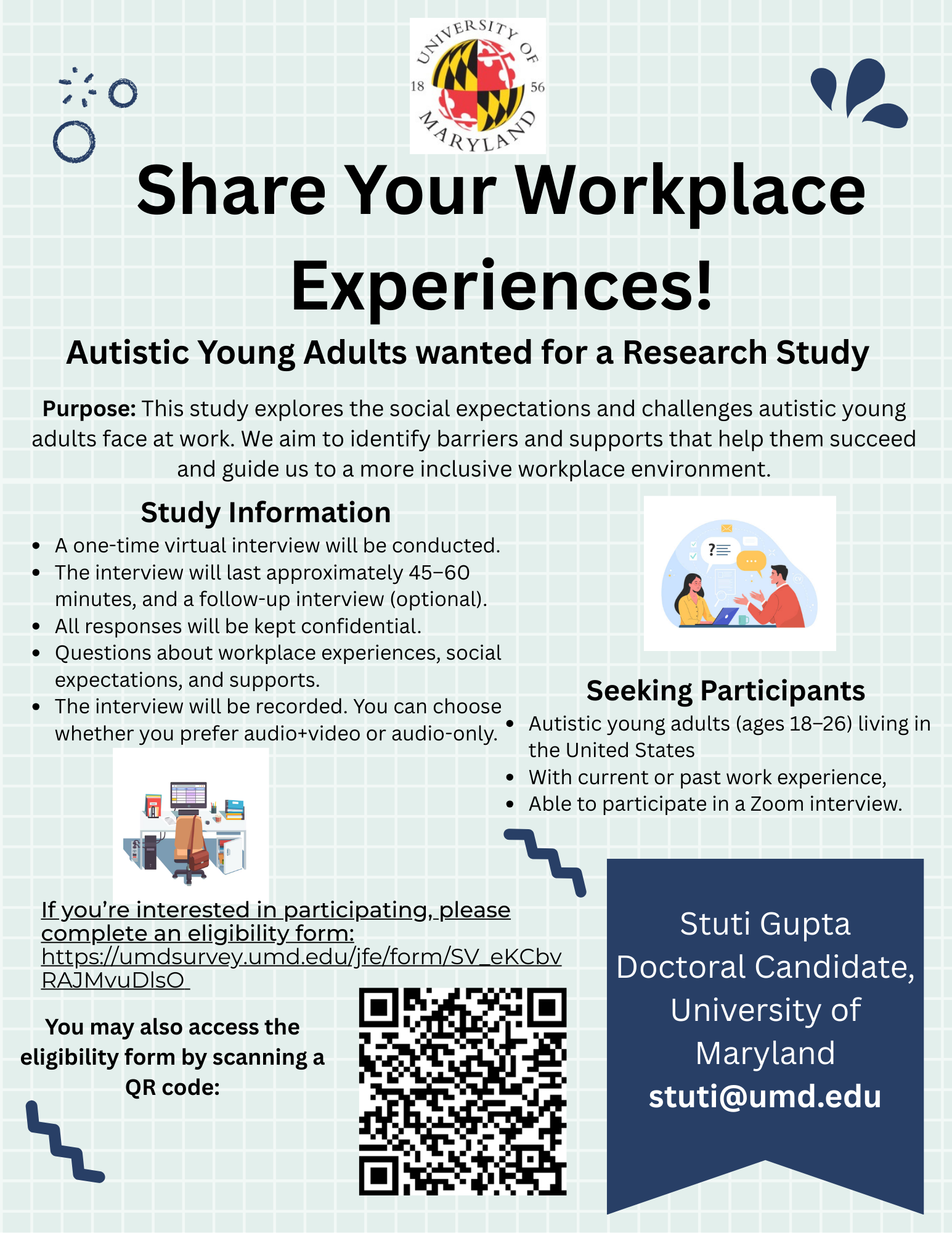
This study explores the workplace social experiences of autistic young adults. It examines the social expectations they encounter in employment settings, the challenges they face navigating workplace interactions, and the supports that help them maintain employment. By centering the perspectives of autistic young adults, the study aims to provide insights that can inform more inclusive workplace practices and supports.
Who can participate?
(1)Individuals who have either a formal or self-diagnosis of autism spectrum disorder or an autism spectrum condition,
(2) be between the ages of 18 and 26,
(3) have current or past experience with paid employment (full-time or part-time),
(4) reside in the US, and
(5) Be able to communicate in English,
(6) Can be verbal or non-verbal.
Please note that participants can provide typed or written answers, use Augmentative and Alternative Communication (AAC) devices, or utilize the Zoom chat feature.
What will participants be doing?
Participants will first complete a brief online screening questionnaire (approximately 3–5 minutes) to determine eligibility for the study. Individuals who meet the eligibility criteria may be invited to complete a consent form and provided with a Qualtrics link to complete a demographic survey (which may take 5-10 mins). Once the consent form is received, participants will be invited for a one-time semi-structured interview on a mutually convenient day and time.
The interview will focus on participants’ perspectives on workplace experiences, including workplace social expectations, social-communication demands, challenges encountered, barriers to maintaining employment, and supports such as accommodations, communication tools, and workplace practices that help participants succeed. The interview will be conducted via a secure university Zoom platform and will last approximately 45–60 minutes. Participants will have the option to participate using video and audio or audio only, based on their preference. With participants’ permission, the interview will be audio-recorded to enable accurate transcription and analysis (Please note that an audio recording is required for research purposes). Lastly, participants may be invited to an optional follow-up meeting to verify interview transcripts and summaries of study findings. Interested participants may choose to provide written feedback or participate in a follow-up meeting with the researcher via Zoom lasting approximately 20–30 minutes. This meeting will also be conducted via the secure university Zoom platform and may be audio-recorded, with participants choosing whether to enable video.
Participation in the study is voluntary, and participants may choose not to answer any question or withdraw from the study at any time without penalty. The total time commitment for participants will be approximately 50–65 minutes, including the screening questionnaire and the interview.
Why is this important?
Many autistic young adults experience challenges related to workplace social expectations that can affect their ability to maintain employment. While existing research has explored employment outcomes and social skills training for autistic individuals, much of the literature has primarily focused on the perspectives of employers, teachers, and parents. The voices of autistic individuals themselves—particularly regarding workplace social skills and expectations- remain limited in the research literature.
This study aims to explore the social skills expectations and challenges that autistic young adults encounter in the workplace as they seek to maintain employment. Specifically, the study seeks to identify the barriers autistic young adults face and the effective support mechanisms that help them navigate workplace social expectations. It will examine the types of social challenges autistic individuals experience at work, how these challenges may affect job retention, and the strategies and supports that have helped them address them.
Additionally, the study will explore how support mechanisms such as workplace accommodations, training programs, and social communication aids influence autistic young adults’ ability to manage workplace interactions and succeed in their professional roles. By centering the lived experiences and perspectives of autistic individuals, this research aims to generate insights that can inform the development of more inclusive workplace practices, supports, and training programs. Ultimately, the findings may help educators, employers, and service providers better understand how to support autistic young adults in achieving and maintaining successful employment.