
Neuroimaging Predictors of Improvement to Pivotal Response Treatment (PRT) in Young Children With Autism
What's the study about?
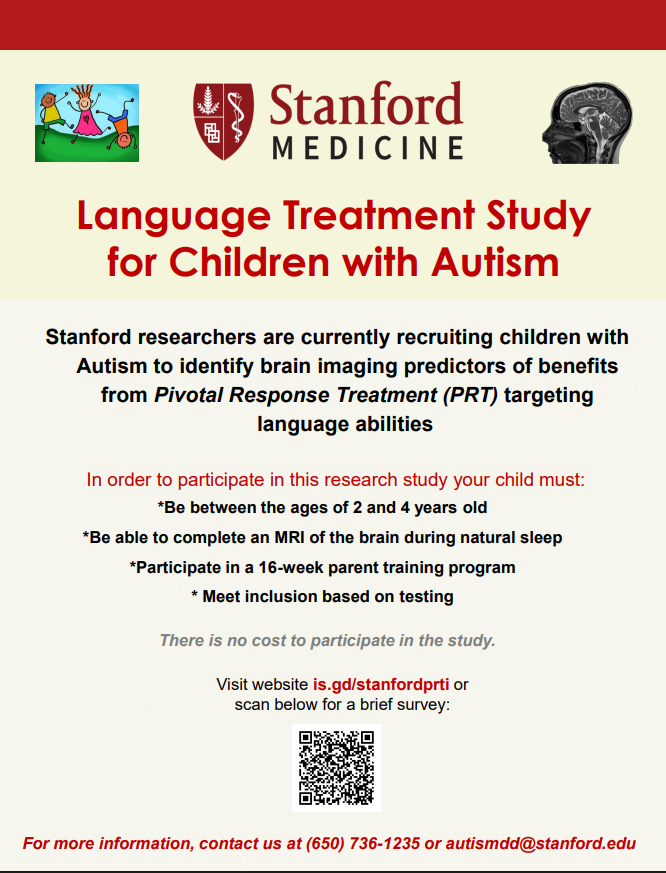
The goal of this pilot investigation is to apply a biologically-based approach to identify predictors of treatment response in children with ASD who are receiving Pivotal Response Treatment (PRT), an evidence-based behavioral intervention.
Specifically, we propose to identify neuroimaging biomarkers of treatment response to a PRT program (PRT-P) targeting language deficits in young children with ASD who will be randomized to either PRT-P or to a delayed treatment group (DTG).
Who can participate?
Children with a diagnosis of Autism Spectrum Disorder (ASD) between the ages of 2 and 4 years 11 months, and their Parents over the age of 18.
What will participants be doing?
This study involves up to a 5 month time commitment. The participant must be willing to complete cognitive and behavioral assessments (such as IQ and language testing) and be able to sleep in the scanner during an MRI.
After a successful MRI, the participant will be randomized into the PRT trial or DTG (Delayed Treatment Group). PRT will consist of 16 weekly, 60-90 minute sessions of parent training in PRT over a 16 week time period.
DTG will consist of your child’s treatments as usual in the community and measurements and questionnaires will need to be filled out on three study visits over the course of the 16 weeks. After completion of the DTG, the participant will be offered PRT parent training sessions similar to the PRT group.
Why is this important?
The goal of this pilot investigation is to apply a biologically-based
approach to identify predictors of treatment response in children
with ASD who are receiving Pivotal Response Treatment (PRT), an
evidence-based behavioral intervention. We hope to address questions
about treatment response in Autism Spectrum Disorders for which there
are no adequate animal models.