Next Generation Siblings (Next Gen Sibs) Project
What's the study about?
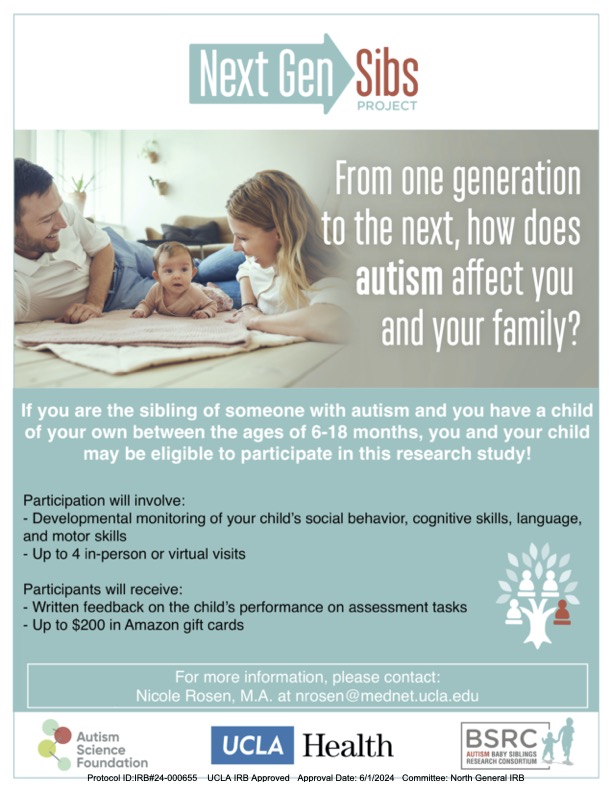
The Next Gen Sibs project is a multisite research study exploring how autism traits run in families. Past research shows that kids who have an older sibling on the spectrum have a higher likelihood of being diagnosed with autism themselves. Now, we’re branching further out on the family tree to look at kids whose parents have a sibling with autism. By tracking this “Next Generation” from infancy for the first time, we hope to gain more insight into early signs of autism, how it affects families over generations, and how we can best support these families and kids as they grow.
Who can participate?
Parents who have a sibling diagnosed with autism and a baby aged 12 months or younger. The study is conducted across multiple research sites in the United States, Canada, and the United Kingdom, offering both in-person visits and telehealth options for participating families.
Note: In order to participate in the study, at least one biological parent must have a biological sibling with an autism diagnosis. We are interested in the very early trajectories of development, so we hope parents contact us before the infant is one year of age.
What will participants be doing?
During in-person or virtual visits, researchers assess developmental milestones at six month intervals (from 6 months to 2 years of age), with up to four 2-hour visits. These evaluations include questionnaires and interviews about the child’s development, sensory experiences, and behaviors. Behavioral assessments of the child will be completed through standardized play activities to evaluate general development including social, cognitive, and motor skills. Some measures will be repeated at multiple visits to monitor progress and change.
Why is this important?
By tracking this “Next Generation” from infancy for the first time, we hope to gain more insight into early signs of autism, how it affects families over generations, and how we can best support these families and kids as they grow.