
Oxytocin, Brain Activity, and Behavior
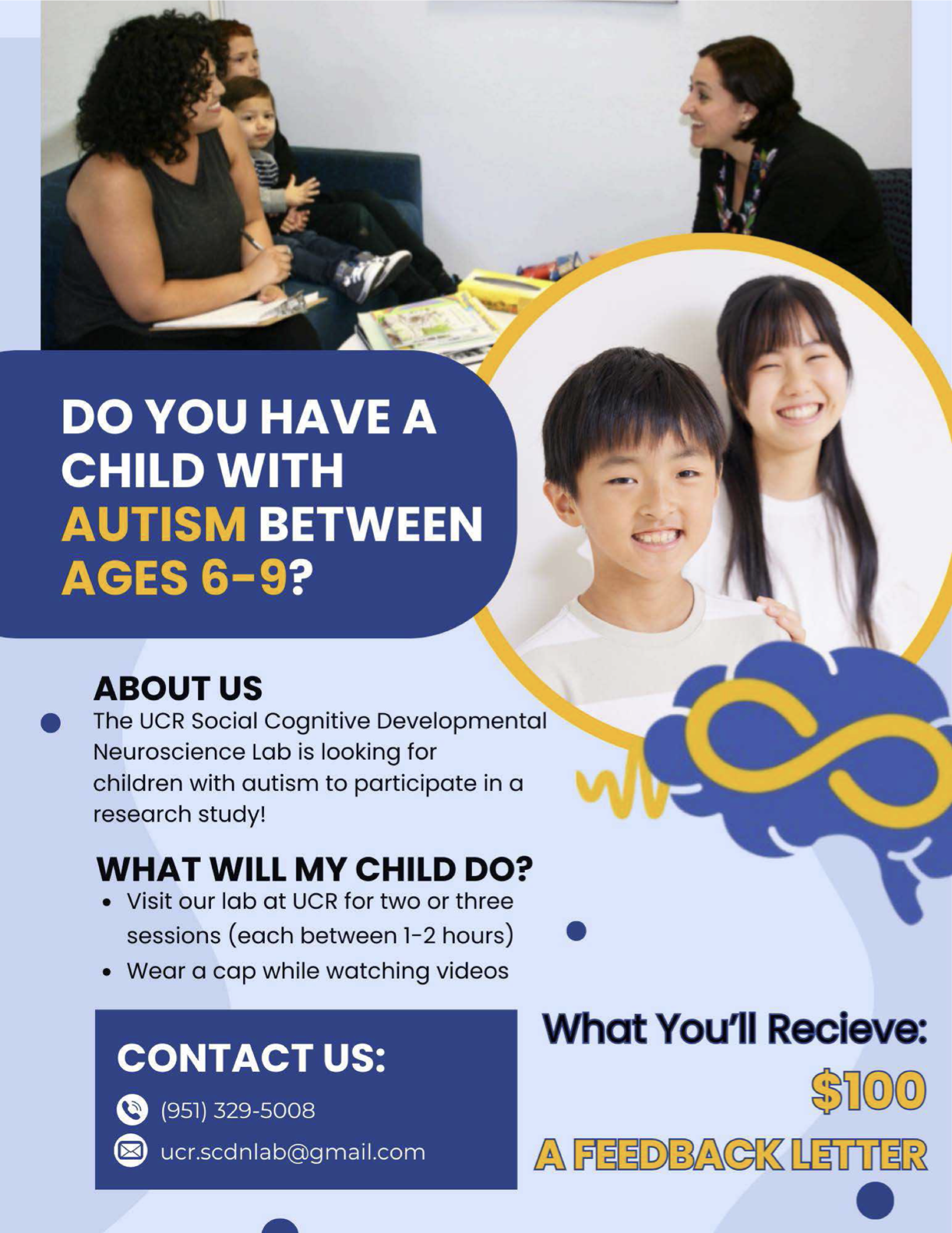
What's the study about?
The purpose of this study is to measure children’s (ages 6-9) brain activity and behavior, as well as measure the amount of oxytocin present in saliva. Oxytocin is a hormone which naturally exists in our body and brain. It affects both social behaviors and emotions. Evaluating brain activity and behavior in relationship to the amount of oxytocin in a child’s saliva is investigational. To measure brain activity, children are presented with images on a computer screen to better understand how children are motivated, and about how social motivation and anxiety relate to autism spectrum disorder (ASD). To measure behavior, children are videotaped while interacting with their caregivers. Some participants will have a previous diagnosis of ASD, and others will not.
Who can participate?
All participants in this study must be children (ages 6-9). They must have normal vision or vision corrected by contact lenses or glasses. All participants must be physically healthy. Also, because the instructions in this study will be presented in spoken English, only English-speaking children are eligible to participate. Participation in this research study is completely voluntary. Children with an intellectual disability are unfortunately unable to participate.
What will participants be doing?
If you decide to take part in this study, you and your child will be asked to come to the UC Riverside’s Social Cognitive Developmental Neuroscience (SCDN) Lab for two visits scheduled at your convenience. The brain activity portion of the study will last approximately 30 minutes, and the behavioral portion will last approximately 60-75 minutes during the first visit, and 15 minutes during the second visit. The first visit will take approximately 2 hours, and the second visit will take approximately 1 hour. To measure how much oxytocin is present in your child’s saliva, your child will provide saliva samples by chewing on a cotton swab for one minute at the beginning of the study session, and one minute at the end of the session. These samples will be analyzed to determine the amount of oxytocin in the saliva. All saliva samples will be stored with a subject number and will not have any personalized information about your child (e.g. name, birthdate, etc.). During the electrophysiology portion of the visit, we will attach a cap (similar to a swim cap) with electrodes to your child’s head. EEG works by placing electrodes close to or on the scalp along with electrolyte gel (similar to ultrasound gel) to measure electrical activity that is naturally on the scalp emitted from the brain. The EEG
cap will be placed on your child’s head, and then gel will be applied with a blunted needle. We will advise your child to wash the gel from his or her head immediately after completing the experiment. You have a choice to wash your child’s hair in the lab as we have a sink specific for hair washing equipped with towels and
shampoo. Or, you can wait to wash your child’s hair when you go home.
While your child is seated in a comfortable chair, we will present him or her with pictures (e.g., images of objects, faces) on a computer screen. Your child will make behavioral responses (e.g. being asked to press a button whenever he or she sees a picture of a house) during the EEG portion of the study. During the study, a
video camera will display your child’s actions for the experimenter to monitor eye movements and body movements, but the session will not be recorded. This session lasts approximately 30 minutes. During the behavioral portion of the visit, your child will be administered standardized measures to assess cognitive abilities, as well as behavioral measures of autism spectrum disorder (Autism Diagnostic
Observation Schedule; ADOS). Cognitive abilities will be assessed using one of the following: Differential Ability Scales, or Wechsler Abbreviated Scales of Intelligence if your child has not been assessed with these measures in the last 6 months, and if this seems appropriate given your child’s development and abilities. Finally, you and your child will be videotaped while having a short, naturalistic (e.g. 5-7 minute) conversation.
Why is this important?
To better understand how children are motivated, and about how social
motivation and anxiety relate to autism spectrum disorder (ASD).