
Parent-Child Interaction Therapy (PCIT) for Minimally Verbal Children with Autism and Their Families
What's the study about?
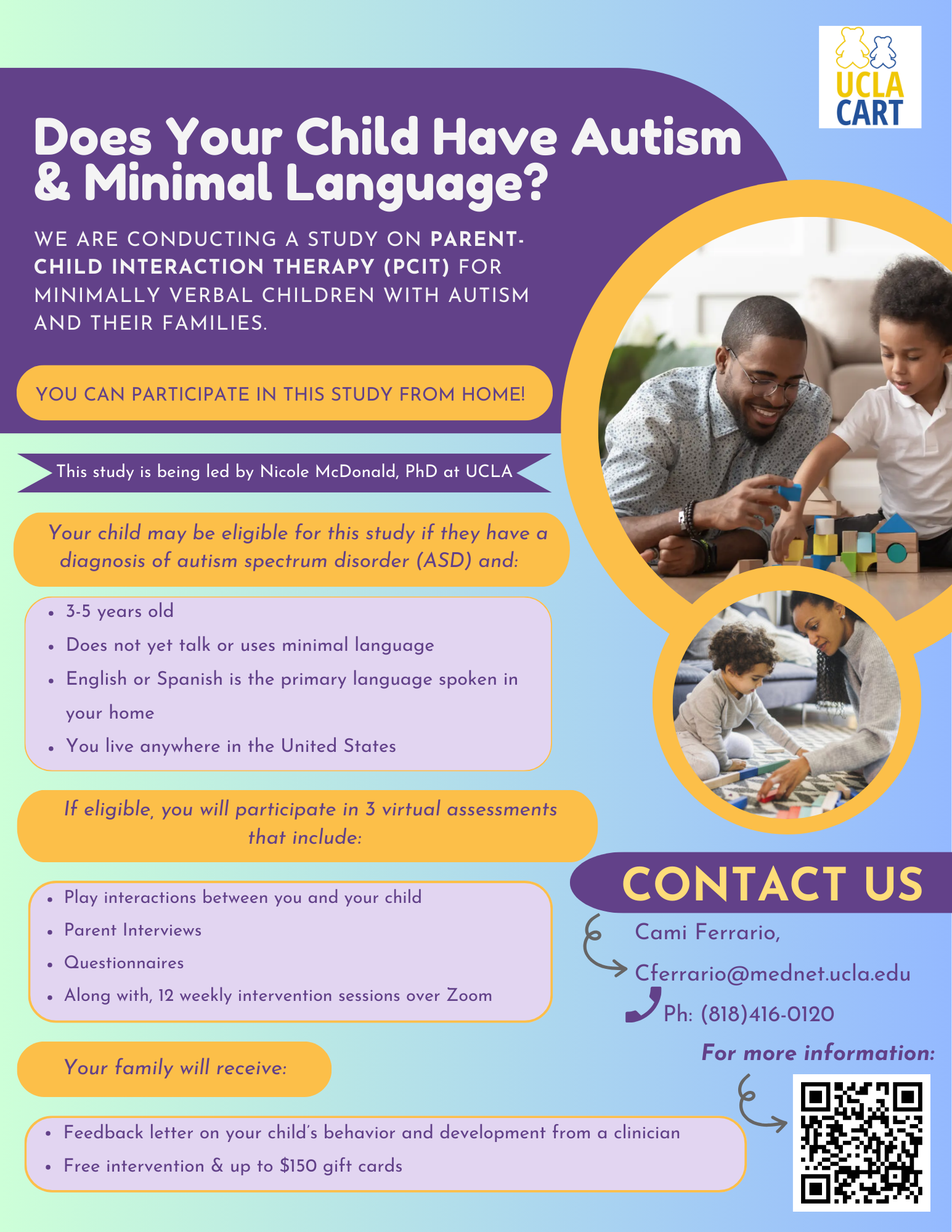
We are studying ways to support families of young autistic children who have minimal spoken language. Our goal is to understand more about how behavior, social communication, and family stress relate to each other — and to see whether a new adaptation of Parent-Child Interaction Therapy, or PCIT, can be helpful for families.
Who can participate?
Families may be eligible to participate if they have a child who:
-is 3–5 years old
-has a diagnosis of Autism Spectrum Disorder (ASD)
-does not yet talk or uses minimal language
-lives in a home where English or Spanish is the primary language
-lives anywhere in the United States
What will participants be doing?
-3 virtual assessment visits (45min–2.5 hours each) including play interactions, parent interviews, and questionnaires.
-12 weekly virtual sessions of play-based parent-child therapy (45–60 minutes per session).
-In total, participation will last about 6 months.
Why is this important?
This study will provide valuable knowledge about how to best adapt Parent-Child Interaction Therapy (PCIT) for minimally verbal autistic children. Families will help us to learn whether this intervention is feasible, acceptable, and potentially effective for improving child and family functioning. Results will also guide future clinical trials, with the ultimate goal of expanding access to evidence-based interventions for families of autistic children with significant communication challenges. More broadly, this research can inform clinical practice, reduce disparities in services for higher-needs autistic children, and contribute to the scientific understanding of parent-mediated interventions in autism.