
Parenting a Child with Autism Caregiver Training Program
What's the study about?
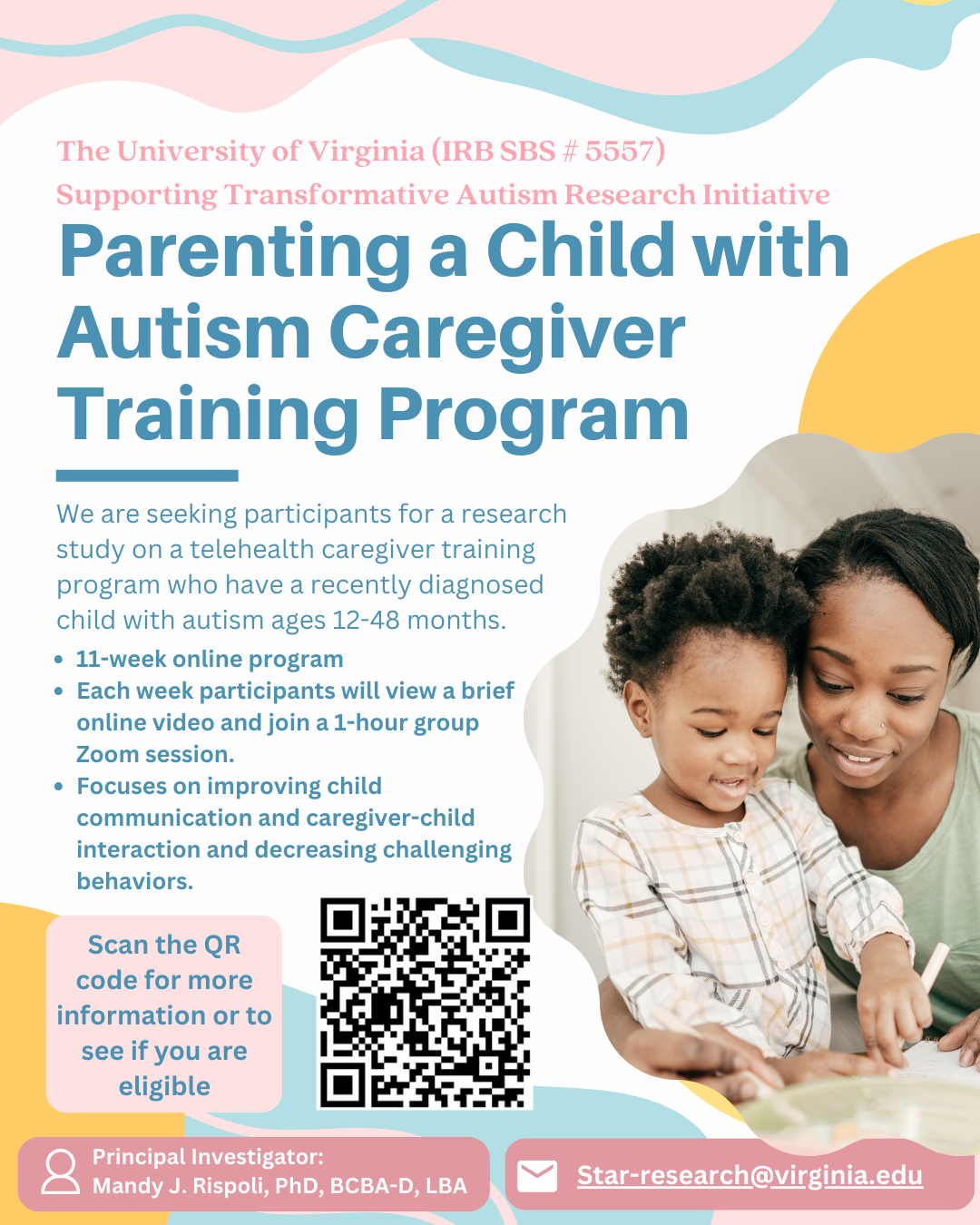
Researchers at the Supporting Transformative Autism Research (STAR) Initiative at the University of Virginia are conducting a research study about a telehealth caregiver training program for caregivers of young children recently diagnosed with autism. The purpose of this study is to see whether a new online caregiver training program for families of young children recently diagnosed with autism improves care and functioning of the child and family.
Who can participate?
The study is currently enrolling 40 caregivers whose child was recently diagnosed with autism spectrum disorder and is between the ages of 12 months and 48 months old. To participate you must have access to highspeed internet, speak English and reside in the state Virginia.
What will participants be doing?
Each week for 11 weeks participants will attend a one-hour caregiver training sessions on Zoom, view a 15-minute online video, and complete one homework assignment. At the beginning and end of the study, participants will complete 8 brief online surveys.
Why is this important?
utism is one of the most common neurodevelopmental disabilities, occurring in all racial, ethnic, and socioeconomic groups with a prevalence rate of 1-2% globally. This complex condition is characterized by deficits in social communication skills, as well as the presence of restricted and repetitive behaviors. Early diagnosis and engagement in interventions improve developmental outcomes and reduce care costs for many children with autism, yet there are many barriers to accessing these services. Disparities are greater
for children from diverse sociocultural groups and under-resourced regions, such as rural Virginia. There is a critical need for locally adapted, community-based autism programs that train family caregivers to support their children with autism.
The objectives of this study are to (1) design a functional core curriculum to be implemented within a telehealth group-based setting with families of children recently diagnosed with autism in Virginia and (2) perform a pilot evaluation of its impact on family quality of life, parental distress, and distal child outcomes. The rationale for developing this curriculum is to address the
need for autism services, which are limited in rural settings. To achieve these objectives, we propose the following specific aims:
Aim 1: Develop a telehealth group-based training curriculum for family caregivers of children recently diagnosed with autism.
Aim 2: Determine whether telehealth group-based caregiver autism training improves parental distress and quality of life and child challenging behavior and communication in Virginia.