
Promoting Early Intervention Timing and Attention to Language
What's the study about?
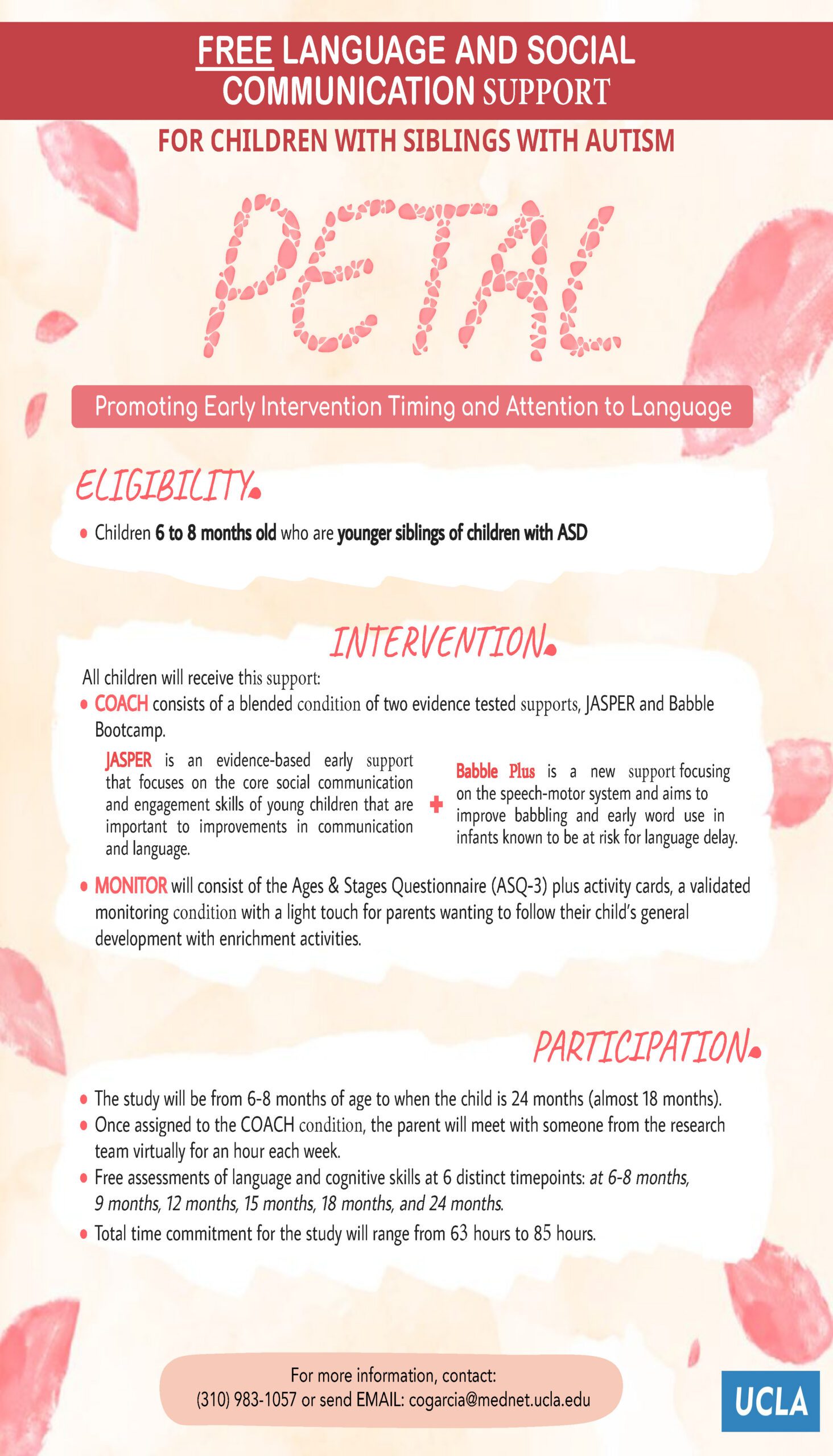
The proposed study (PETAL: Promoting Early intervention Timing and Attention to Language) aims to determine the timing of intervention among infants with Increased Likelihood for Autism (ILA; at risk for autism by virtue of having an older sibling with autism) on communication and language outcomes at 24 months. Results of this study will determine when (9 vs 12 vs 15 months), and based on which measures (brain, language, or their combination) to augment parental support with a specialized parent-mediated coaching intervention for optimal outcomes on communication and language at 24 months.
Who can participate?
Infants aged 6-8 months old who are siblings of children with ASD.
What will participants be doing?
There will be 6 assessment time points:: entry, 9 months, 12 months, 15 months, 18 months and when child turns 24 months.
Entry assessments which will include:
Filling out questionnaires about your demographics and your child’s treatments and services they receive if any.
Assessments on expressive language, gestures, and child engagement will also be administered. Your child will also be asked to wear a vest for an assessment called LENA for an entire day. This vest records the child’s language environment. You will have the option to turn it off when you need privacy.
EEG that will monitor child’s dysregulations.
Movement sensors and motor development assessments that take 2 days.
The testing session will take approximately 3 hours.
Support which includes:
Phase 1 begins at age 6-8 months; after baseline demographic, language, behavior and brain assessments, all children are offered the MONITOR condition. Phase 2 begins at age 9 months; after language, behavior and brain assessments, all children are randomly assigned to transition to MONITOR plus COACH (with probability 1/3) versus continue with MONITOR (with probability 2/3). Phase 3 begins at age 12 months; following language, behavior, and brain assessments, children who have not yet transitioned to MONITOR plus COACH are randomly assigned (with equal probability) to transition to MONITOR plus COACH versus continue with MONITOR. Phase 4 begins at age 15 months; following language and behavior assessments, all remaining children will transition to MONITOR plus COACH.
The MONITOR condition will provide parents with information to track the early development of their infants, along with specific developmentally targeted activities. The well validated Ages and Stages-3+ screening tool along with activity cards will provide information to parents at each age.
All parents will receive these materials at 3-month intervals, along with a developmentally chosen toy and book for their infant. The MONITOR condition continues for all infants and parents throughout the study period even after receiving COACH condition.
The COACH condition consists of a blended condition of two evidence tested supports, JASPER and Babble Plus. Infant-parent dyads will be randomized to receive COACH (JASPER Babble) at 9, 12 or 15 months. JASPER Babble addresses early parent-child social
communication by helping to close the ‘feedback loop’. When parents talk and play with their infant, the infant increases their developmental behaviors which serve to provide more opportunities for parents to respond. For infant-parent dyads randomized to COACH, we will set up once weekly remote (zoom) 1-hour coaching sessions in between assessment visits each 3 months. Similar to the ASQ-3+ monitoring condition, parents will have access to the support team on as needed basis throughout the study if they request more input, and we will track this contact. Once randomized to COACH, parents will continue to receive the remotely delivered support throughout the study period.
Additional assessments at 9 months, 12 months, 15 months, 18 months, and 24 months: The testing sessions will take approximately 1-1.5 hours and include the following assessments: Assessments on expressive language, gestures, and child engagement will be administered at all time points.
Your child will also be asked to wear a vest for an assessment called LENA for an entire day during these time points. This vest records the child’s language environment. You will have the option to turn it off when you need privacy.
EEG that will monitor child’s dysregulations (only at 9 months,12 months, and 24 months).
Movement sensors and motor development assessments that take 2 days (only at 9 months and 12 months assessments).
ADOS-2 will be administered at the 24-month time point only. This is a diagnostic evaluation, but for research purposes only.
Participation will include a total of 16-18 months.
Why is this important?
Parents benefit from the study by receiving detailed information about their child’s language and communication skills both before the support begins and after the support is completed.
The results of the research may also contribute to society by enhancing our knowledge of intervening on social communication.