
Register Prototypicality in Autistic Individuals: Investigation of Register-Specific Texts by Autistic versus Non-Autistic Language Users
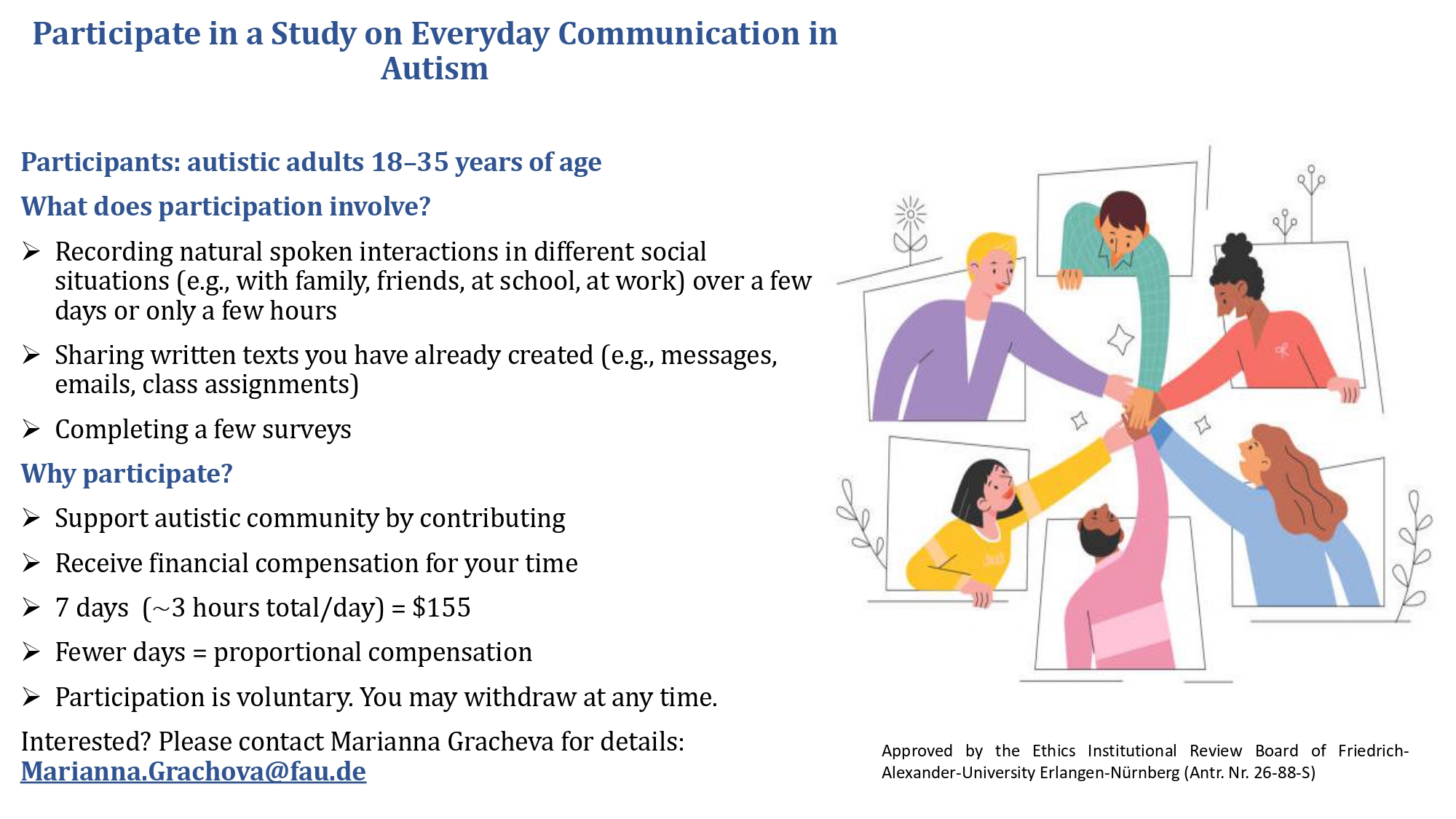
What's the study about?
The study examines how autistic adults use language in different everyday situations, such as talking with friends, participating in a study group, or attending a work meeting, compared to non-autistic adults. To do this, we will collect examples of spoken and written language used in different situations, such as conversations with friends, classroom discussions, work meetings, and emails, from autistic and non-autistic individuals. These texts will be analyzed to identify patterns in how language is used across situations and groups. This research will provide new insight into autistic and non-autistic communication across contexts and may help inform future educational and communication resources and support initiatives.
Who can participate?
Autistic individuals between 18-35 years of age, who have been officially diagnosed with ASD.
What will participants be doing?
Study Description as it appears on the participants’ informed consent form:
1. Overview and Main Goal of the Study
During the time span of 7 days, which you can spread across up to 3 weeks, you will be asked to record language that you produce in your everyday life when you communicate with friends, family, at school, or at work—about 3 hours per day.
You will also be asked to share texts that you have produced in writing: for example, emails, text messages, memos written for work, or any school tasks, such as class essays. The written texts do not have to be produced during the same week; they can be any texts you are willing to share.
You can record any texts but please prioritize the following:
-Spoken interactions: with family, with friends, at work (e.g., with employers, co-workers), at schools (e.g., study groups with classmates, office hours with professors)
-Written texts: text messages or direct messages, social media posts, class assignments (e.g., essays, class papers), emails.
It is okay if you cannot collect this wide variety. It is still very helpful if you submit texts from 2 or 3 of these spoken and written registers.
Please note that if there is something you do not want to share, you do not need to submit that particular interaction or text.
In summary, this project collects the spoken and written texts you produce in your daily life. You do not need to do anything beyond what you do on your typical days. The task is to carefully record these data using your phone or another device of your preference, name these recordings following the format the researcher will explain, and submit these texts to the researcher.
You will, however, need to ask everyone you talk to whether they agree to be recorded. We will provide you with a single link to a consent form, study information, and a short survey that you will send them. We will make this process quick and easy for you and your interlocutors, but this is an important step to keep in mind.
2. Procedure
Before you begin, you will receive a short questionnaire from the researcher (2 mins) and an Autism Quotient Test (5-10 mins) and take part in a Zoom meeting with the researcher (ca. 15-20 mins) so that we can confirm that you can participate, explain the steps to you, and answer your questions.
You will then start recording texts on any day of the week; you can skip days on which you do not have enough interactions. You can also split the 3 hours of a single day into several days. The 7 days of data collection thus do not have to be consecutive. You can take as long as 3 weeks to collect your 7-day data.
After Day 1, you will submit your data to the researcher to make sure that you understood the task correctly and the texts are clear and legible. Once the researcher approves, you will then continue with Days 2, 3, etc. and submit all texts—spoken and written—at the end of Day 7. If after Day 1 you need clarification, we can schedule a Zoom meeting to clarify the instructions before you continue.
We advise that you name your files using the naming convention given to you by the researcher at the end of each day. You can also do that at the end of data collection, but it is easier to remember detail about the interaction if you name them daily.
3. Submission
You will submit all recordings and written texts using a link provided by the researcher. You will be asked to follow a particular file naming pattern for clarity.
Together with your files, you will submit a survey (~15 mins) about your experience with data collection. It will include questions about your age, neurotype, the registers in your day, and your thoughts about differentiating between them.
Why is this important?
Autism communication research (see, e.g., de Marchena et al., 2025, for a review) has raised important questions on the role of discourse context in autistic language users’ ability to interpret linguistic meaning (e.g., Frost et al., 2025), highlighted differences to non-autistic participants in sensitivity to the changing situational cues and degrees of corresponding language adaptation (Koch et al., 2026), posited that autistic individuals focus on the local and specific rather than the surrounding, global context to interpret meaning (Weak Central Coherence theory, Happé & Frith, 2006), and suggested the existence of an autistic linguatype (Zane & Luyster, 2025)—a language style identifiable in multiple autistic speakers similar to a dialect or register (Zane & Luyster, 2025, p. 1519). Such studies are typically lab-based experiments, focusing on a particular linguistic construct (e.g., indirect requests, Frost et al., 2025; neologisms, Zane & Luyster, 2025), and a comprehensive linguistic account of autistic language based on a multitude of linguistic features and across real communicative situations (i.e., from a register-functional corpus-based perspective, Biber, 1988) has not yet been attempted. Register research, concerned with situationally determined linguistic variation, is uniquely positioned to study linguistic challenges stemming from speakers’ interpretation of natural communicative situations but to date has not engaged with populations known to experience such challenges. This exploratory study is intended as a first step toward bridging this gap and aims to investigate cross-situational linguistic shifts in autistic individuals compared to their non-autistic peers in natural communicative situations of language use, providing a comprehensive linguistic description of autistic language from a corpus-based text-linguistic register perspective. In doing so, this study aims to contribute towards our understanding of the autistic “linguatype” as proposed by Zane & Luyster (2025).