
Self-Reporting OCD Symptoms in Autistic Adults
What's the study about?
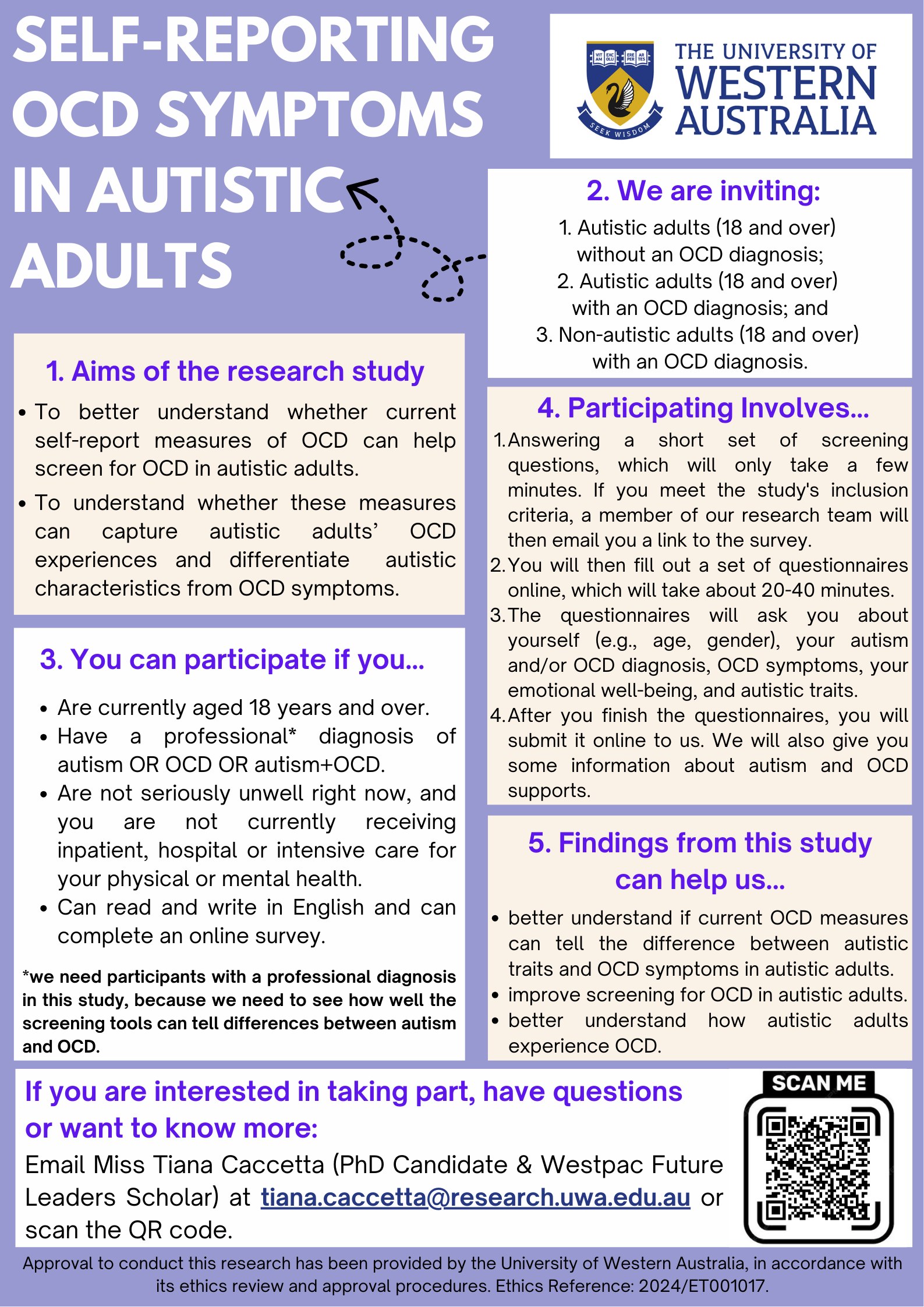
This study wants to find out if the checklists we use to check for OCD can help
identify OCD symptoms in autistic adults. We want to see if these checklists can
tell the difference between autistic traits and OCD symptoms in autistic adults.
We are also looking to find out if these checklists can show us what OCD is like
in autistic adults.
Who can participate?
You can take part in this study if:
1. You are 18 years old or older, AND
2. A health professional diagnosed you with:
a. Autism, OR
b. Obsessive-Compulsive Disorder (OCD), OR
c. Both autism and OCD; AND
3. You are not seriously ill right now, and you are not currently receiving inpatient, hospital, or intensive care for your physical or mental health; AND
4. You speak English and can complete an online survey.
What will participants be doing?
Participating involves…
1. Answering a short set of screening questions, which will only take a few minutes. If you meet the study’s inclusion criteria, a member of our research team will then email you a link to the survey.
2. In the survey, you will fill out a set of questionnaires online, which will take about 20-40 minutes. You can take a break if needed, but you must keep the page open and finish the survey in one go.
3. The questions will ask you some things about yourself (like your age, gender, etc.), your autism and/or OCD diagnosis, your OCD symptoms, your emotional health, and autistic traits.
3. After you finish the questionnaires, you will submit it online to us. We will also give you some information about autism and OCD supports.
Why is this important?
While OCD affects about 1-3% of the general population, studies suggest that OCD is much more common in autistic adults (up to 24% in autistic adults; Hollocks et al., 2019). However, due to the significant behavioural overlap between autistic characteristics and OCD symptoms, it can be difficult to distinguish between the two. Moreover, there is a gap in the research with few studies having reported whether current self-report measures of OCD can capture autistic adults’ experiences and differentiate autistic characteristics from OCD symptoms. Thus, this study is an important start in better understanding whether current self-report measures of OCD can adequately screen for OCD in autistic adults. The findings from this study can help us: (1) better understand if current OCD measures can tell the difference between autistic characteristics and OCD symptoms in autistic adults, (2) improve screening for OCD in autistic adults, (3) better understand how autistic adults experience OCD.