
Sensory Over-Responsivity Across the Spectrum
What's the study about?
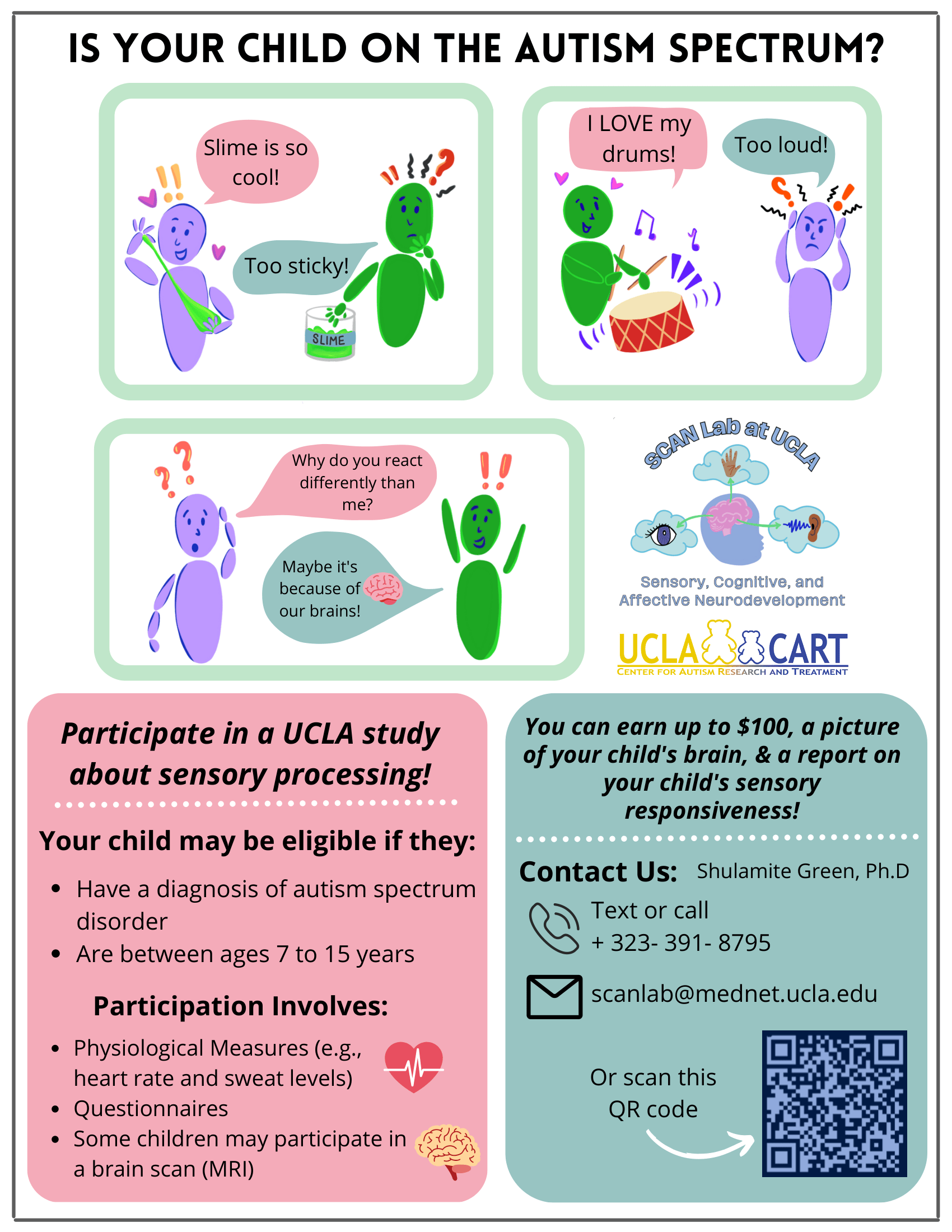
Sensory Over-Responsivity Across the Spectrum is a UCLA study led by Dr. Shulamite Green and the SCAN Lab that examines how children across the autism spectrum process and respond to sensory input. The study focuses on brain and physiological responses to visual, auditory, and tactile stimuli, with the goal of understanding why certain sensations feel overwhelming or distracting for some children. Unlike prior sensory neuroscience research that has largely included only children with verbal and cognitive skills in the average range, this study intentionally includes children with a broad range of language and cognitive abilities. Children participate in interactive sensory tasks while researchers measure natural body responses such as heart rate, along with cognitive and autism-related assessments, parent and child questionnaires, and an optional noninvasive MRI brain scan. By capturing sensory responses across diverse levels of functioning, the study aims to generate findings that can inform more inclusive, developmentally appropriate supports and interventions for autistic children and their families.
Who can participate?
Children may be eligible if they: have a diagnosis of autism spectrum disorder, are between 7 to 15 years of age, can understand simple phrase speech, are able to communicate their needs using spoken language, an AAC device, or sign language, and can remain seated and relatively still for short periods of time.
What will participants be doing?
Children will visit UCLA for two to three study visits. During these visits, children will complete brief cognitive and autism-related assessments, take part in interactive sensory games involving visuals, sounds, and touch, and wear noninvasive sensors to measure natural body responses such as heart rate. Parents and children will complete questionnaires about sensory experiences and daily functioning. Some children may also be invited to participate in an optional, noninvasive MRI brain scan to help researchers understand how the brain responds to sensory information.
Why is this important?
Sensory challenges affect many autistic children and can interfere with learning, emotional regulation, and daily functioning, yet sensory neuroscience research has historically focused on a narrow subset of children with higher language and cognitive abilities. This study addresses that gap by examining brain and physiological responses to sensory input across a broader range of children on the autism spectrum. By identifying biological patterns associated with sensory over-responsivity, the findings may help guide the development of more inclusive, developmentally appropriate supports, therapies, and educational strategies. In the long term, this research has the potential to improve how sensory needs are understood, accommodated, and addressed in clinical, school, and home settings for autistic children and their families.