
Social Groups for Autistic Young Adults (SDARI)
What's the study about?
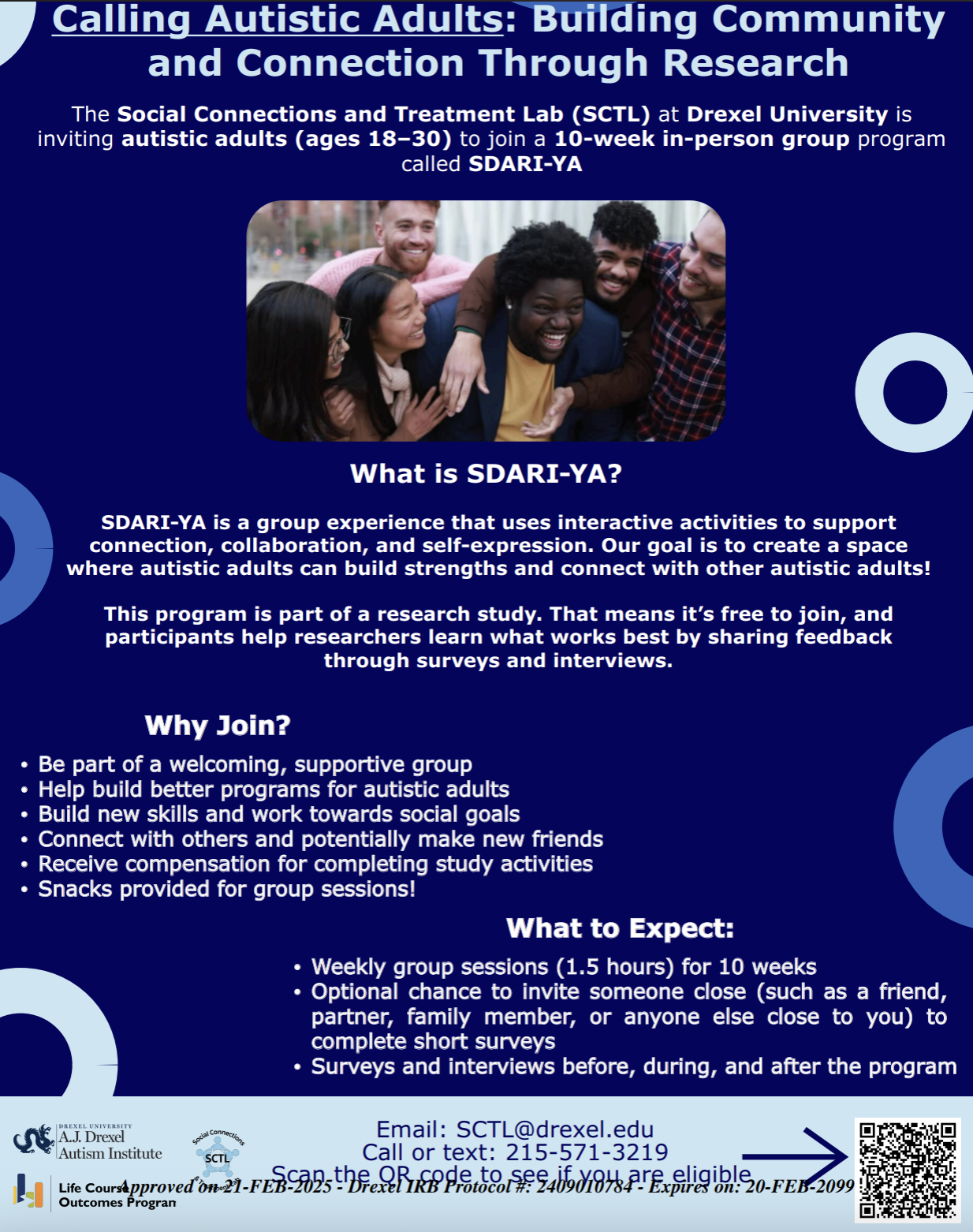
We are looking for autistic young adults to help us understand the experiences of autistic adults participating in social groups. SDARI is a group experience that uses interactive activities to support connection, collaboration, and self-expression. Our hope and goal is to create a space where autistic adults can build strengths and connect with other autistic adults!
Who can participate?
Autistic adults ages 18-30 are encouraged to participate. Participants must be able to travel to the AJ Drexel Autism Institute in Philadelphia, PA for 11 in-person visits (one screening visit and 10 1.5 hour group sessions). Participants should be able to complete study measures in English.
Participants will be screened to confirm autism diagnosis and an IQ measure will be administered to confirm eligibility for this study (IQ > 70).
What will participants be doing?
Eligible participants will:
1. Be randomized (by chance) to one of two social groups and attend weekly 90-minute sessions for 10 weeks in person at AJDAI at Drexel University in Philadelphia, PA;
2. Complete questionnaires and interviews across multiple timepoints throughout participation in this study;
OPTIONAL: Participants may choose to elect somebody else close to them (such as a caregiver, family member, friend, or romantic partner) to complete additional measures about the participant during 3 timepoints.
Why is this important?
Social challenges are significant clinical feature in autism. Social skill interventions are among the most common form of intervention used to address social skill challenges, but there are notable methodological limitations in the studies that examine the treatment efficacy of social skills interventions for individuals with autism.
Rigorous studies such as this study which utilize appropriate methods and comprehensive designs are needed to improve and refine social skills treatment approaches. This is especially a need within the autistic adult population because adults frequently lose access to services around their transition out of high school.
This program’s fun and engaging environment provides participants repeated opportunities to practice social skills, and through repeated use, participants increase social motivation and skill generalization.