
Studying Autism and ADHD Risks (STAARS)
What's the study about?
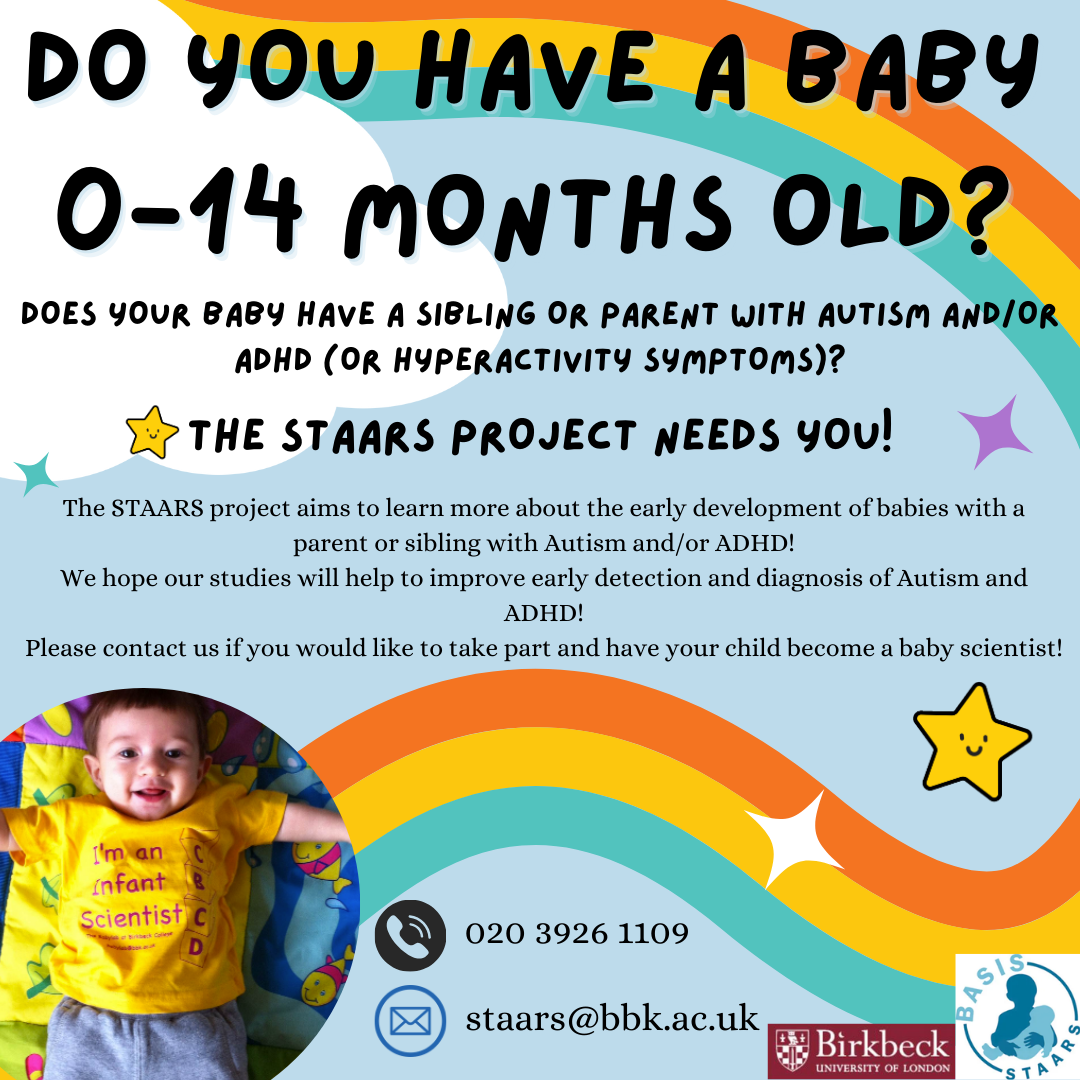
We are studying differences during development in infants who have a first-degree relative (i.e. brother, sister, or parent) with Autism Spectrum Disorder (ASD) an/or Attention Deficit Hyperactivity Disorder (ADHD) and those who do not. It is our hope that our research will help us gain a better understanding of why some children develop ASD or ADHD and others do not. Although the tasks we use in our research studies cannot predict or diagnose ASD or ADHD, we hope to use our findings to develop new tests that may in the long-term, help us to support children with ASD and/or ADHD earlier.
Who can participate?
Infants 0-14months old who have a first degree relative (sibling or parent) with a diagnosis of ASD and/or ADHD
What will participants be doing?
If you are interested in participating in the study, we will first collect background information about your family in order to determine whether this study is suitable for your child. This will occur over the phone. If the study is not suitable for your family you can choose to join our database to hear about other future studies that might be a better fit. If the study is suitable for your family, we will invite you and your child to visit our research centre, the Babylab at the Centre for Brain and Cognitive Development in London. Depending on your willingness and the age of your child when he/she is recruited, we will invite you to participate for a maximum of four visits until your child is 18 months. Later we will invite you for two follow-up visits, one at 2 and one at 3 years of age respectively. A typical visit takes place over 5-6 hours, which includes time for meal and nap breaks. We aim to be flexible to you and your baby’s needs and you can choose to split the visit over two days if that is more convenient for your family. We can provide a range of support to help you and your family participate in our study, and so please let us know if you have any additional needs.
Why is this important?
We hope to find early indicators of either disorder in order to develop more targeted early interventions.