
The Role of Parental Self-Efficacy and Stress in the Implementation of Nutrition Strategies for Children with Autism Spectrum Disorder
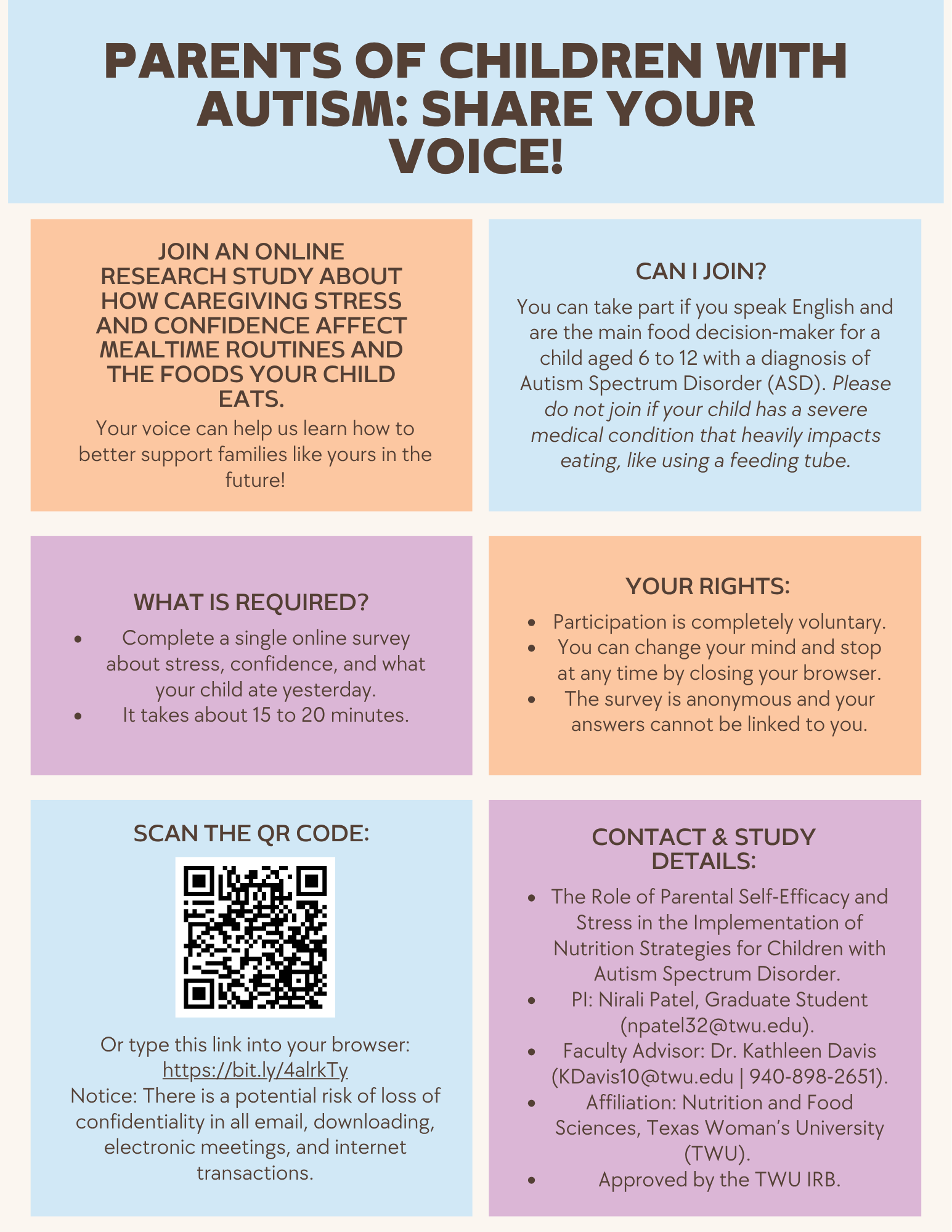
What's the study about?
We want to learn how caregiving stress and confidence connect to mealtime routines and the types of food your child eats. Our goal is to find better ways to support families like yours in the future.
Who can participate?
You can join our study if you meet these rules:
You are the main caregiver who makes food choices and meals for your child.
Your child has a medical diagnosis of ASD.
Your child is between 6 and 12 years old.
You can speak and read English.
Note: Please do not take this survey if your child has a severe medical condition that heavily changes how they eat or digest food (such as relying on a feeding tube).
What will participants be doing?
You will fill out an online survey about your stress, your confidence as a parent, and the types of food your child ate yesterday. The survey is completely confidential. The survey takes about 15 to 20 minutes to complete in one sitting.
Why is this important?
This study is important because it looks at how a parent’s stress and confidence affect their ability to help their child with autism eat a healthy variety of foods. Children with autism often struggle with severe food selectivity, which can lead to poor nutrition and long-term health issues. While feeding programs teach strategies like structured routines and repeated exposure, they often fail to account for how overwhelmed or confident parents feel when trying to use them. By identifying how caregiver stress acts as a barrier and self-efficacy acts as a support, this research will help clinical dietitians design better interventions (combining feeding advice with support for parents’ mental well-being) to ultimately improve nutrition and mealtime success for these children.