
Through a New Lens: Using Photo Elicitation and Narrative Inquiry to Explore the Identity of Late-Diagnosed Autistic Adults
What's the study about?
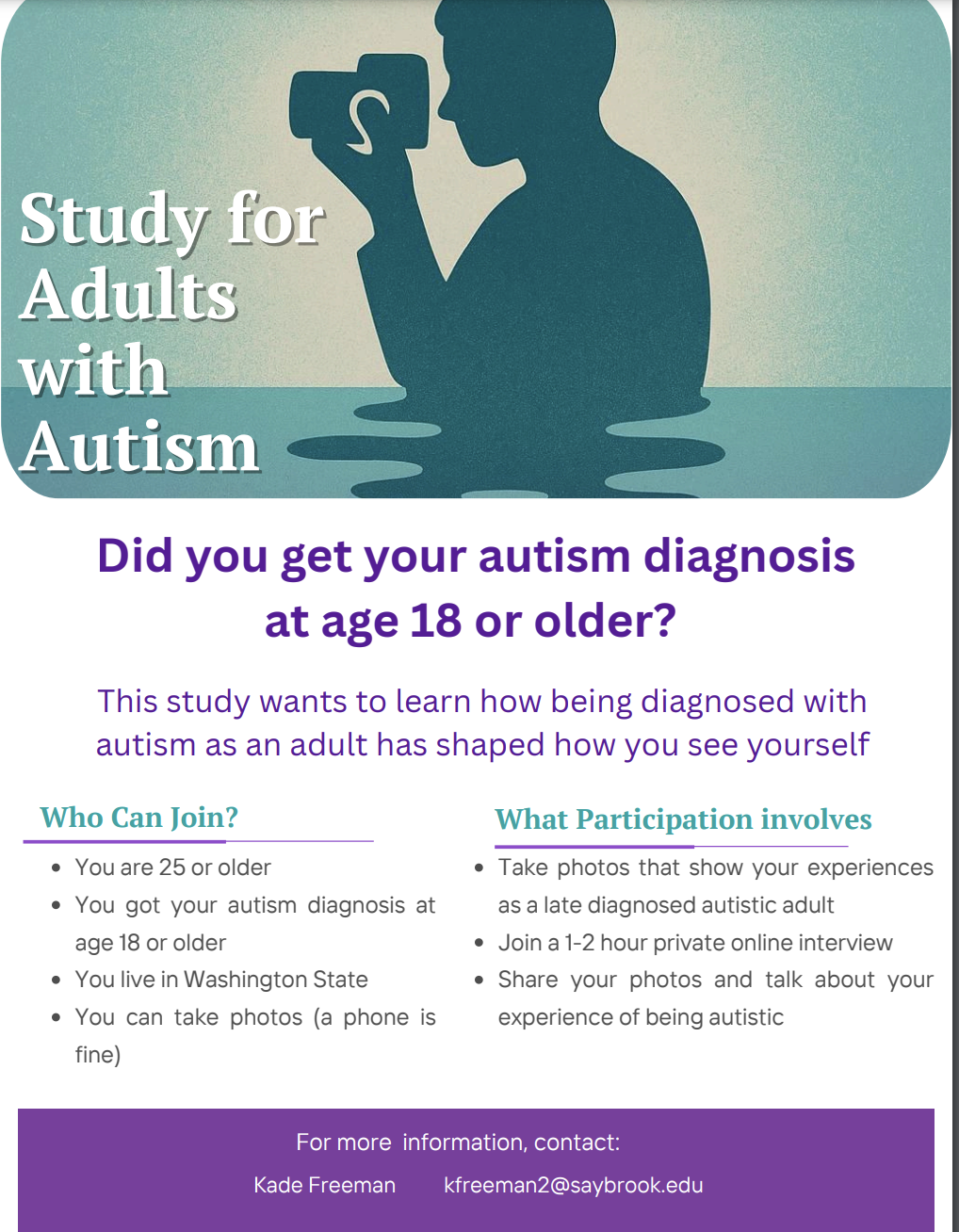
This study explores how adults who were diagnosed with autism later in life make sense of their identity after diagnosis. Participants will be asked to take or select a small set of photographs that represent their experiences before diagnosis, their current sense of self, and how they view their future. These images will be used as prompts during a one-time, semi-structured interview conducted via Zoom or in person, lasting approximately 60 to 90 minutes. Interviews will focus on participants’ personal narratives and the meaning they assign to their diagnosis and identity. The goal of this study is to better understand the lived experiences of late-diagnosed autistic adults and to inform more affirming clinical practice and support.
Who can participate?
Adults age 25 and older who have been formally diagnosed with autism at age 18 or later are eligible to participate. Participants must live in the United States, be able to complete an interview in English, and be willing to take or select a small number of photographs to support a one-time interview about their experiences. Participants must also be able to provide informed consent.
What will participants be doing?
Participants will first complete a brief eligibility screening and informed consent process. They will then be asked to take or select three photographs that represent their experiences before diagnosis, their current sense of self, and how they view their future. Participants will take part in one semi-structured interview, conducted via Zoom or in person, lasting approximately 60 to 90 minutes. During the interview, they will be invited to share their experiences and the meaning behind their photographs. The interview will be audio-recorded for transcription, and participants will have the option to review and edit their transcript afterward.
Why is this important?
This study is important because the experiences of adults who are diagnosed with autism later in life are still underrepresented in research, particularly in relation to identity and meaning-making. Many existing studies focus on diagnosis or clinical traits, while fewer center the lived experiences of autistic adults themselves. This study creates space for participants to share their own narratives and perspectives, including how they understand themselves before and after diagnosis. By centering these experiences, the findings can help inform more neuroaffirming and person-centered approaches in clinical practice, improve how providers talk about and support identity development after diagnosis, and contribute to a broader understanding of autism that reflects autistic adults’ voices.