
Transcranial Direct Current Stimulation (tDCS) for Children Aged 6-10 years old
What's the study about?
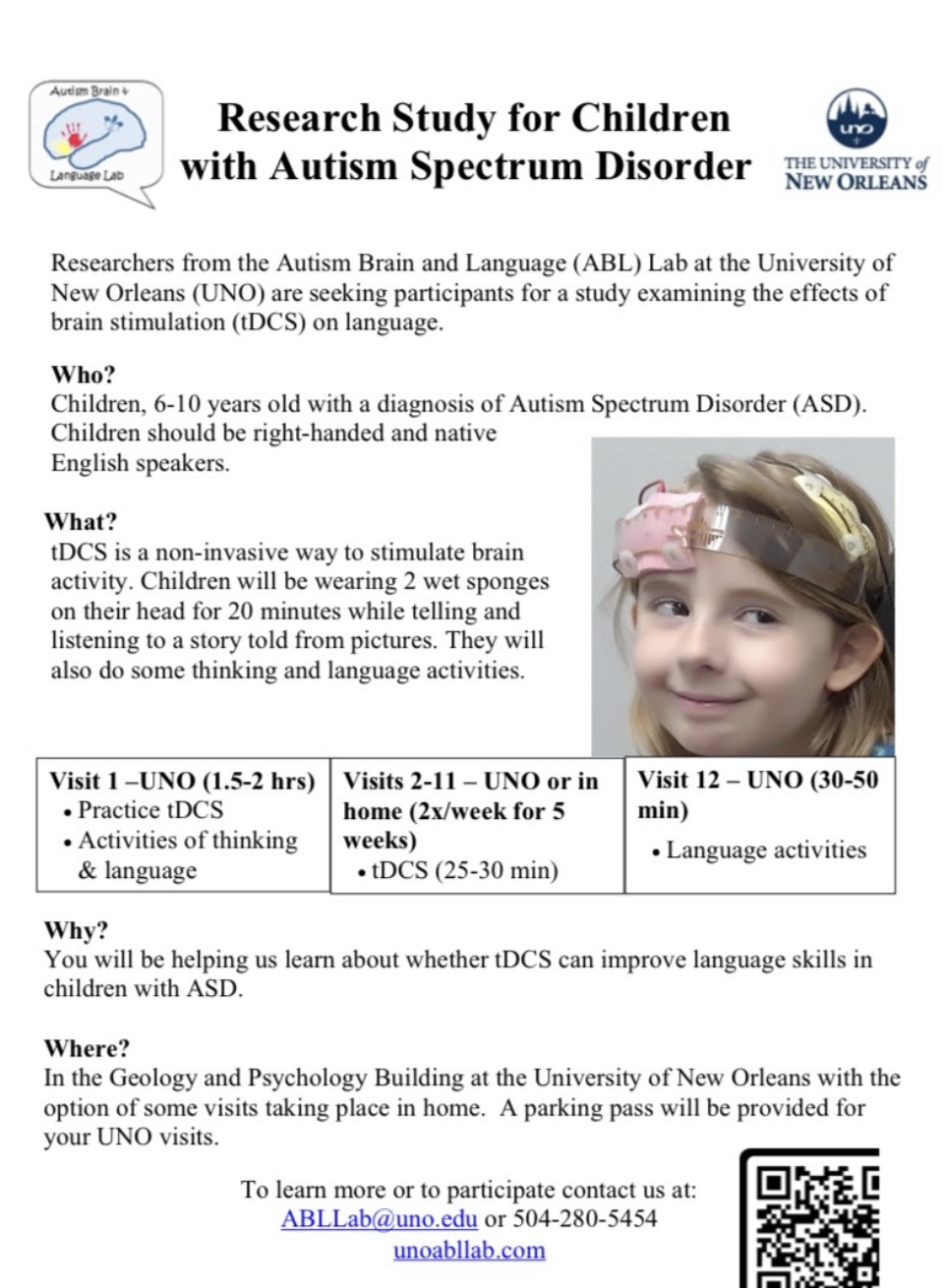
We are studying the utilization of tDCS in an autistic population because it has shown to be useful in treatment populations of stroke and Alzheimer’s patients, specifically helping with language and behavioral issues. tDCS is thought to stimulate the language and processing part of the brain, which could absolutely be beneficial to the ASD community, especially those who are less verbal on the scale. tDCS has been proven to be a safe form of neuromodulation that has been shown to increase the likelihood of brain activity. Our lab’s research goal is to investigate through this pilot study whether tDCS can be beneficial for individuals with diagnosed Autism Spectrum Disorder (ASD) that might face language or behavioral difficulties. Generally, we want to learn more about tDCS’ ability to change how the brain processes language information.
Who can participate?
6-10 year olds, with a documented official diagnosis of Autism Spectrum Disorder (ASD). Right-handed preferred, left-handed are welcome to join as well!
What will participants be doing?
The pre-visit, as mentioned above, typically takes 1 1/2-2 1/2 hours (maximum), and is the first point of contact. This meeting occurs on UNO’s campus in our lab. We will spend time talking, walking you through all the lab procedures, and you and your child’s rights of consent and ability to stop participation at any time. Once we go through the introduction and paperwork, and you meet the lab members, including the head of our lab, Dr. Knaus, we will simply put the equipment on your child (with consent, and with your help if it is more comfortable). Nothing is on at this point, we are just making sure your child can handle the sensory experience of the equipment before continuing. If all if well, we will continue with a “test trial”, in which we turn the tDCS stimulation on for approximately 30 seconds. This is also to ensure your child is comfortable and able to handle the sensory experience. If your child is comfortable to continue, we will then do a 20 minute introductory session of tDCS stimulation while looking at a picture book with the child. If all goes well in the pre-visit, we can continue on to the next weeks of trials.
Visits 2-11 can occur at the UNO lab, or with your permission, at your residential home. We provide this service to make it easier on the families, because we are aware of how much of a time commitment this would be. Whether the next visits occur in the lab or at your home, they are two times a week over a 5 week period (with your family choosing availability). Each of these visits is 25-30 minutes, and utilizes tDCS stimulation while looking at/reading different children’s books with your child. If at any of these visits your child becomes uncomfortable, or there is a particular day in which the child may not be feeling well, we will simply skip the tDCS that day, or if it becomes necessary we can stop altogether at any time.
After 5 weeks of twice weekly visits to your home or to our lab, there is one last visit. This visit occurs at UNO lab and lasts 30 minutes-1 hour (maximum). We do some final language activities with tDCS stimulation, but we also wrap up our research, discuss any findings from either side, and of course ask you and your child about your overall experience, mainly so we can improve in any way.
Why is this important?
This study could potentially benefit ASD communities by positively promoting and stimulating the language production and processing areas of the brain, as it has in stroke and Alzheimer’s patients. Overall, this could be a non-invasive and accessible treatment that could benefit many children with ASD, especially those with language and reading difficulties.